
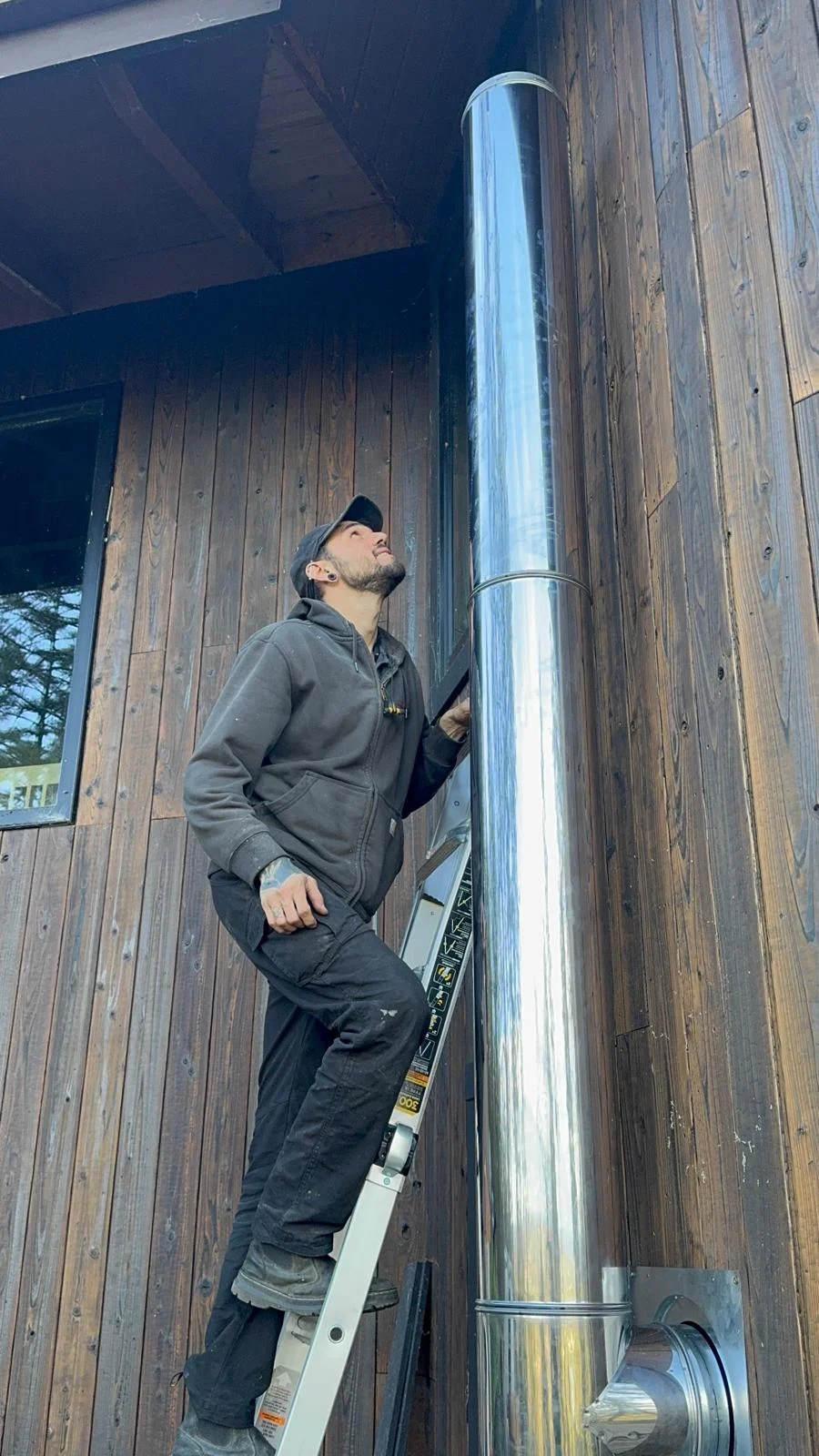
Do I need a chimney liner?
You need a chimney liner if the flue is cracked, missing altogether, or undersized for whatever appliance is connected to it. Signs include smoke backing into the room, a lingering burning smell, staining running down the outside brick, or a home inspection report flagging deteriorated flue tile.
Any one of those is worth a look. Don’t wait for the next fire. Here are the five I see most.
- Smoke backs into the room instead of drawing up the flue, even with the damper fully open.
- A home inspector’s report flags cracked, missing, or deteriorated flue tile during a sale or refinance.
- Rust-colored or white staining runs down the outside of a metal or masonry chimney after rain.
- A wood stove or fireplace insert was connected to an old masonry flue that was never sized for it.
- A flashlight down the flue shows daylight through a gap, or loose tile pieces sitting on the smoke shelf.
What is a chimney liner, and which type fits your home
A chimney liner is the passage smoke travels through, whether that’s clay tile built into the original masonry, a metal tube run down after the fact, or a poured refractory shell. Its job is simple: move heat and smoke up and out, and carry hot gas and creosote out above the roofline without touching the brick, the wood framing, or the air in your house. If you want the full rundown of what’s actually up there, the parts of a chimney explained covers the flue, the crown, and everything around it.
Three types cover almost every chimney I open in this area. Here’s how they compare.
| Liner type | What it is | Best fit |
|---|---|---|
| Stainless steel | A rigid or flexible metal tube run down the existing flue, sized to whatever appliance connects to it. | A sound masonry flue, or any wood stove or insert that needs a properly sized connection. |
| Cast-in-place | A refractory cement mix poured around a bladder that gets pulled once it cures, forming a new smooth-walled liner. | Cracked or crumbling clay tile that also needs structural strength back, not just a new interior surface. |
| HeatShield | A cerfractory sealant troweled or poured against the existing clay tile, closing gaps and cracks without tearing the old tile out. | Tile that’s cracked but the flue is still straight and round enough to seal instead of replace. |
Stainless steel is the one I install most often. It handles both a straightforward reline and a brand-new wood stove hookup. Cast-in-place and HeatShield solve a narrower problem: a flue whose tile is compromised but whose structure is otherwise sound. Whether you call it chimney liner replacement or flue liner replacement, it comes down to the same decision. Replace the whole passage, or seal what’s already there.
Here’s something that trips people up. Not every chimney can even take a liner. Most of the prefab metal fireplaces in the 1960s and 70s tract houses across Carmichael and Citrus Heights were built as a sealed factory unit, with a double-wall metal pipe running through a chase instead of a masonry flue. There’s nothing there to line. When that pipe fails, it doesn’t get relined. It gets swapped for a new listed unit, end to end.
What a chimney liner installation costs in Sacramento
I quote from a starting number, not a range, and a liner isn’t one of the six jobs that gets a number over the phone. Chimney liner installation cost depends on the liner type, the height of the flue, whether it runs straight or has an offset partway up, and how much old tile has to come out first. None of that is knowable up front. It’s not a guess I’m willing to make sight unseen.
| Service | Starting price |
|---|---|
| Chimney inspection | $59, deductible against the job |
| Basic chimney cleaning | from $199 |
| Chimney cap installation | from $350 |
| Chimney crown rebuild | from $350 |
| Dryer vent inspection | $59 |
| Dryer vent cleaning | from $150 |
A liner sits outside that table. That’s on purpose. So does the question of how much to reline a chimney, in a single sentence. It depends on too much. Guessing wouldn’t be honest. If you want the full breakdown of what moves a liner number up or down, chimney liner cost covers it in more depth, and you can check the price band before you commit to any repair on the list, liner included.
One thing worth saying plainly: chimney liner cost per foot isn’t how I price a job. Length is one input among several, and quoting by the foot before anyone’s measured the offset, the material, and what’s coming out first is how a number ends up wrong on install day.
Call (916) 833-2959 and ask for the $59 inspection, 7am to 7pm, seven days. That $59 comes off the liner install if you go ahead, so the real number costs you nothing extra to get.
How a chimney liner install happens
Every liner job here runs the same four stages, in this order.
- I inspect the flue first, with a flashlight and a camera scan on anything I can’t see straight down. That’s what the $59 pays for.
- I size the liner to the flue and the appliance connected to it, and pick stainless, cast-in-place, or HeatShield based on what the flue actually needs.
- I install it myself, top to bottom, on the day we agree to. Nobody else shows up on your roof.
- I test the draft once it’s connected, and walk you through what I did before I leave.
The liner is selected after the flue and appliance are measured. This page doesn’t promise a material or listing before that inspection.
When you don’t need a new liner
If the flue is straight, round, and the tile is intact with no cracking or gaps at the joints, you don’t need a liner. Get it inspected on a normal schedule and leave it alone. A lot of what gets sold as a failing liner is really just a dirty one. It looks worse under a flashlight than it is once it’s swept.
The exception is anything hooked to a wood stove or insert that was never sized for it. That liner didn’t fail on its own. It was wrong for the job from day one, and cleaning it won’t fix that.
Is chimney relining required by code in California?
Not automatically. A working, undamaged flue doesn’t have to be relined just because the house is old. What actually triggers it is usually a home inspection ahead of a sale, a new wood stove or insert that needs a properly sized flue, or an insurer asking for proof the flue is sound after a fire or storm. The standard most inspectors and installers work from for flue lining is NFPA 211 explained, which goes into the specifics in more detail than fits here.
Related repairs while I’m already up there
A liner job rarely happens in isolation. Rarely just one thing. If the mortar around the flue is soft or crumbling, that’s chimney masonry repair service territory, and it’s worth doing in the same visit instead of a second trip up the same ladder. A chimney that’s visibly leaning or separating from the house is a different category, closer to chimney rebuild service than a liner fix. And if the reason you’re relining in the first place is a new fireplace insert installation in Sacramento, the liner and the insert usually get sized and installed together, since an open fireplace flue is almost always oversized for an insert’s exhaust.
Why a licensed installer matters here
An undersized or poorly sealed liner doesn’t announce itself right away. Not at first. It shows up as a smoke smell that won’t clear, or creosote running down the outside brick the following winter, long after whoever installed it has moved on to the next job. Getting the size and the seal right the first time is most of what a liner install actually is.
Americas Chimney Sweep is licensed CSLB #1150991, C-29 Masonry, active and current. Look it up yourself. No pressure either way.
What Sacramento-area chimneys need from a liner
The foothills wear a liner out faster. Foothill homes around Nevada City and Grass Valley burn wood daily through the winter, not for a handful of fires a season. That kind of steady heat cycling ages a clay tile liner faster than an occasional valley fire ever does, so cracked tile up there gets found sooner and gets sealed or replaced before creosote finds every gap in it. Down in the valley, most liner calls trace back to a new insert install or a home-sale inspection instead of daily wear.
I run this service across five counties out from Nevada City, and dryer vent cleaning in Sacramento is one of dozens of pages covering the towns in that stretch.
What people say after a liner job
Google has this business at 4.95 across 62 reviews, a small enough count that you can read every single one instead of trusting an average. A customer named Brian put it this way: “The owner was incredibly prompt, professional, and highly communicative.” I’ve replied to all 62 myself.
If you want more than one quote, hear it from someone who is not us instead of taking my word for it.
Chimney liner installation FAQs
What is a chimney liner?
It’s the passage inside the chimney that carries smoke and hot gas out above the roof, whether that’s clay tile, a metal tube, or a poured refractory shell. Its job is keeping heat and creosote away from the brick and the framing around it. When it fails, everything downstream of it gets worse.
How much to reline a chimney?
There’s no flat number, because material, height, and flue shape all change the labor. I quote it after the $59 inspection, once I know which of the three liner types your flue needs. That $59 comes off the job if you go ahead.
How do I find chimney liner installers near me who are actually licensed?
Ask for a license number before anyone gets on your roof. Americas Chimney Sweep is licensed CSLB #1150991, C-29 Masonry, and you can look that number up yourself on the CSLB site before booking anything, no pressure either way.
Is chimney relining near me something I can get scheduled quickly?
Describe what you’re seeing when you call, and I’ll tell you whether it can wait for a normal booking or needs a sooner look. Either way, it starts with the $59 inspection so I know exactly what the flue needs before I put a start date on it.
What’s the difference between chimney liner replacement and a repair?
Replacement means the old liner comes out and a new one goes in. A repair, like HeatShield, seals cracked tile in place without removing it. Which one applies depends on how much of the existing tile is still sound, and that only shows up at the inspection.
How do I compare chimney liner companies near me?
Ask each one for a license number, whether they carry all three liner types, and whether they’ll size the liner to your actual appliance instead of guessing. Anyone who quotes a price over the phone with no inspection is guessing too.
Can I use my fireplace while the liner is being installed?
No. The flue’s not usable once the old liner’s out or the new one’s only partway in, and running a fire through an open chase is a real hazard, not just a mess. Most single-flue jobs finish in a day. Plan on the fireplace being off-limits until I’ve told you it’s back in service.
What changes between a chimney liner and no liner at all?
An unlined flue lets heat and acidic byproducts hit bare masonry directly, and over years that eats the mortar joints and can let heat reach wood framing next to the chase. A liner contains both and gives the appliance a passage sized to draw correctly. It’s the first thing I flag on an older chimney.
Do I need a chimney liner for a gas fireplace?
Often, yes, especially if you’re converting from wood or adding a gas insert. A masonry flue sized for a wood fire is usually too large for gas, and an oversized flue lets combustion byproducts cool and condense before they clear the top. Sizing that liner correctly to the new appliance is most of the job.
HeatShield or a new liner: how do you choose?
HeatShield seals cracked tile that’s still structurally sound, sprayed on as a continuous coating inside the existing flue. A full liner replaces tile that’s missing chunks, badly out of round, or sized wrong for whatever appliance you’re running now. I only know which one your chimney needs after I’ve had a camera down it.
How is a chimney liner installed?
I measure the flue’s length and cross-section against your specific appliance first, since a liner sized wrong won’t draft right. The old flue gets cleared of debris and the winding tile checked, then the new liner gets fed down from the top, wrapped in insulation on most jobs, and connected to the appliance below.
How long does a chimney liner last?
Longer than most people expect if it’s sized right and swept on schedule. What shortens a liner’s life is what runs through it. Daily wood heat in the foothills glazes it faster than a few valley fires a winter, and one that never gets inspected can fail quietly, unnoticed until smoke rolls back.
Insulated versus uninsulated chimney liner: what’s the difference?
Insulation wraps the liner in a blanket that keeps flue gas hot enough to keep rising, instead of cooling and condensing on the walls. It matters most on a masonry chase built for a bigger, hotter fireplace than the appliance now hooked to it. Uninsulated can work, but clearance and listing decide that, not preference.
Is a chimney liner required by code?
Yes, for a chimney being built or rebuilt today. The current California Residential Code requires masonry chimneys to be lined, with the material matched to whatever appliance it’s serving. That’s a different question from whether an old, intact liner has to be swapped out, which the code doesn’t mandate on its own.
Stainless steel versus cast in place, which liner is right?
Stainless is a tube, rigid or flexible, fitted down the existing flue and it’s the faster job. Cast-in-place pours a lightweight cementitious lining directly against the old masonry, which also reinforces a chimney that’s structurally weak, not just relined. If the brick itself is failing, cast-in-place solves two problems at once.
What size chimney liner do I need?
Whatever your appliance’s manufacturer specifies, not the size of the old flue. An oversized liner cools exhaust too fast and lets creosote condense, and an undersized one chokes the draft and can backdraft smoke into the room. I size it off the appliance’s listing and the flue’s actual dimensions, measured at the inspection.
Schedule Service Today
A liner problem doesn’t fix itself over a Sacramento winter. It gets found by a home inspector, an insurance adjuster, or a chimney fire, and only one of those is cheap. Call (916) 833-2959 and ask for the $59 inspection, 7am to 7pm, seven days, and you’ll know which of the three liner types your chimney needs and what it costs before you spend anything else. Or book it while you are thinking about it and I’ll call to confirm the details.