
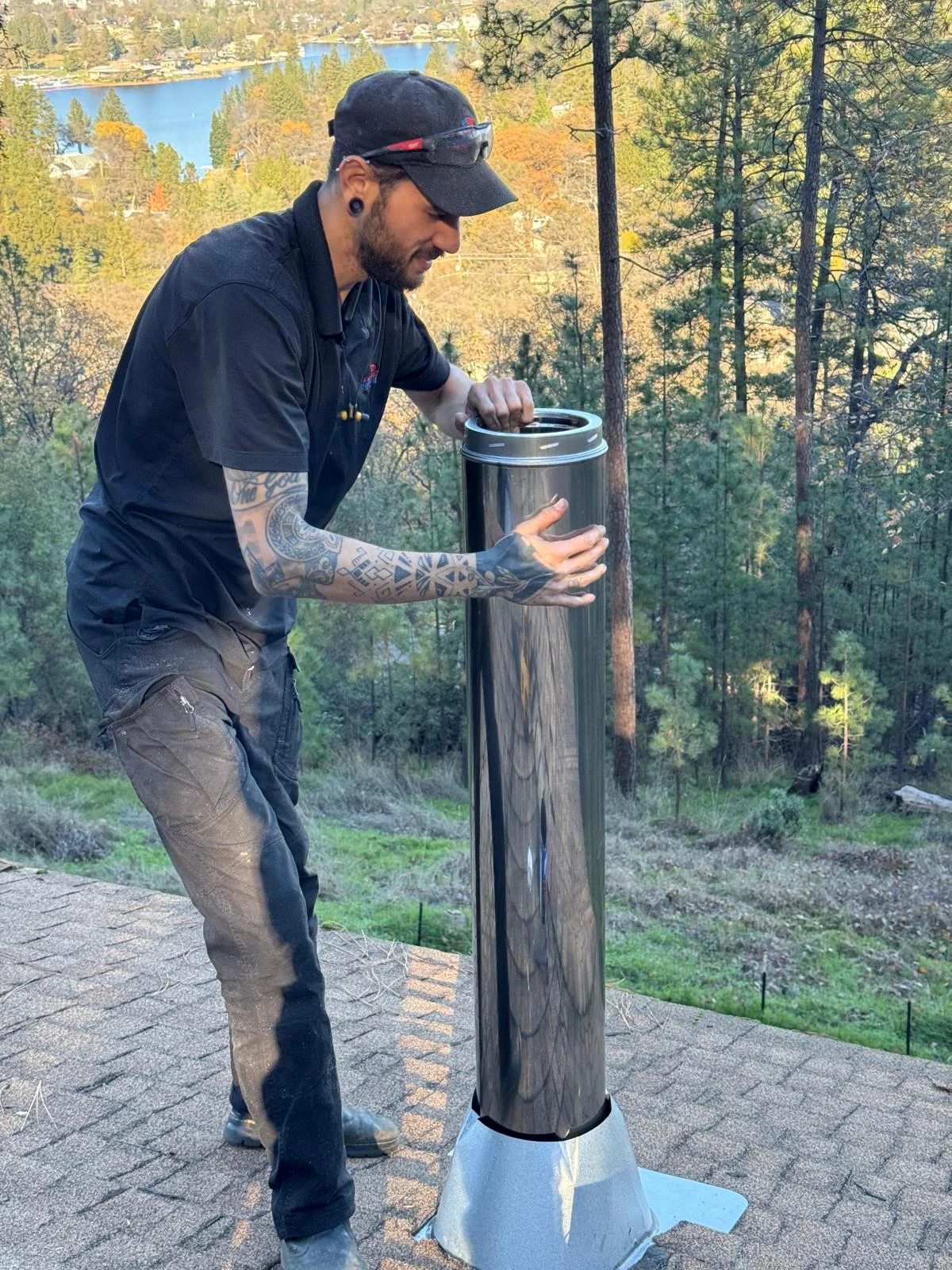
The parts split into three groups: what carries smoke out (firebox, damper, smoke chamber, flue, liner), what sits on top (crown, cap, spark arrestor), and what seals it to the roof (chase, chase cover, cricket, flashing). Skip one and the rest can’t do its job.
Most of what goes wrong with these parts doesn’t show up until water’s already inside, and by then guessing costs more than knowing. The fastest way to find out where you stand is to get it inspected before you light it. A Level 1 look walks every part in the table below and tells you which ones are fine. If something does need work, you want a chimney repair contractor who can tell you which part failed. That might mean a full rebuild, or it might mean just enough work to seal the cracks in the concrete cap on top before the next storm gets under it.
Chimney Anatomy: All 12 Parts in One Table
This is the fireplace parts diagram most people are looking for, in table form so it holds up on a phone screen.
| Part | Where it sits | What it does | How it usually fails |
|---|---|---|---|
| Firebox | Base of the fireplace, indoors | Contains the fire itself | Firebrick cracks or the mortar between joints crumbles from heat cycling |
| Damper | Top of the firebox or the throat above it | Opens to vent smoke, closes to stop draft and pests | Rusts stuck, usually from moisture, not from age |
| Smoke chamber | Just above the damper | Narrows the wide firebox opening down to flue size | Rough parging inside catches creosote faster than a smooth one |
| Flue | Runs the full height of the chimney | Carries smoke and gas out of the house | Blocked by creosote, a nest, or a collapsed liner |
| Flue liner | Lines the inside of the flue | Protects the masonry from heat and acidic byproducts | Clay tile cracks from heat shock, metal liners rust through |
| Chimney crown | Concrete slab on top of the masonry, under the cap | Sheds rain off the top of the stack | Cracks at the flue tile joint, then water gets in |
| Chimney cap | Sits on top of the flue itself | Blocks rain, animals, and debris from the flue opening | Rusts through, or a screen panel comes loose |
| Spark arrestor | Wire mesh built into or added onto the cap | Stops embers from landing on the roof or in dry brush | Mesh clogs with creosote or bends open past code spacing |
| Chase | Wood-framed enclosure around a prefab metal flue pipe | Hides and protects the flue pipe on factory-built fireplaces | Siding fails and lets water track down the frame |
| Chase cover | Flat metal panel on top of the chase | Seals the chase against rain, same job as a crown | Thin galvanized steel rusts through faster than concrete cracks |
| Cricket (saddle) | Roof framing built behind a wide chimney, uphill side | Splits rain and snow around the chimney instead of pooling it | Missing entirely on older builds, or the flashing over it fails |
| Flashing | Metal sheeting where the chimney meets the roof | Seals that joint against water intrusion | Sealant dries out and cracks years before the metal does |
What Is a Chimney Flue?
A chimney flue is the passage that runs the height of the chimney and carries smoke, gas, and heat out above the roofline. It’s not the whole chimney. Just the shaft inside it. On a masonry chimney the flue is usually lined with clay tile; on a factory-built fireplace it’s a listed metal pipe.
The flue is sized to the appliance. Nothing more. Too big, and it drafts weakly, letting smoke roll back into the room on a cold start. Too small, and it chokes the fire and pushes creosote onto the walls faster than normal. Neither gets fixed by cleaning; it takes measuring the firebox opening against the flue, part of what a Level 1 inspection checks.
What Is a Flue Liner?
A flue liner is the material lining the inside of the flue. It does two jobs: it keeps heat away from the brick around it, and it keeps the acidic byproducts of combustion from eating into the mortar joints. Clay tile, stainless steel, and cast-in-place liners are the three you’ll run into. They fail differently.
Clay tile cracks from thermal shock, usually after a chimney fire or years of overfiring. Stainless liners rust from the inside out when they sit wet too long, more common than you’d think on a chimney used only a few times a winter. A house with no liner at all is the one I take most seriously, since the brick alone stands between the fire and the frame next to it.
The Firebox and the Damper
These are the two parts people actually touch, indoors. Homeowners notice them first, and worry about them least.
The firebox is the lined chamber where the fire burns, built from firebrick set in refractory mortar that can take heat cycling without crumbling the way regular mortar would. A rough or chalky firebox is usually years of heat doing exactly what it’s supposed to do, and it gets repointed rather than replaced.
The damper sits above the firebox and opens to vent smoke or closes to stop your heated air from running straight up the flue. The most common damper problem here isn’t a broken part. It’s a stuck one. Rust from moisture, not age, seizes a damper plate in place, and people spray it with penetrating oil for a season before anybody tells them the oil isn’t the fix.
If your fireplace burns gas, the flue and chase still matter, but the burner and gas line are separate from masonry work. Michael does the work himself.
The Chimney Crown and the Chimney Cap
People use these two words for the same thing. They’re not the same part. Not even close.
The crown is the concrete slab across the top of the masonry, sloped so rain runs off instead of soaking in. When a crown is built as a thin flat wash with no overhang past the brick, common on tract houses and older stacks alike, it cracks where it meets the flue tile. That happens the first time the tile heats up and expands. Every fire after widens the crack.
The cap sits above the crown, directly over the flue opening. Its job is narrower: keep rain, birds, squirrels, and debris out of that one hole. A cap can be missing entirely with the crown perfectly intact, and a crown can be cracked with a brand-new cap sitting right on top of it.
What Is a Spark Arrestor?
A spark arrestor is a wire mesh screen, usually built into the cap, that catches embers before they exit the flue and land somewhere they shouldn’t. In a region with dry summers and homes backed up against foothill brush, that mesh does real work most of the year. Not just during a fire.
The failure is almost always the same. Creosote builds up on the mesh from the inside until the openings close. A clogged spark arrestor chokes the draft the same way a blocked flue does. People call about smoke rolling back into the house and never suspect the screen on top.
What Is a Chimney Chase?
A chimney chase is a wood-framed box built around a factory-made metal flue pipe, sided to match the house. It’s not masonry, though it’s often mistaken for one from the ground. Chases are common on 1950s through 70s tract housing across the valley, where builders used prefabricated fireplaces instead of laying brick.
A chase fails at the seams. Not the wall. Siding pulls away at a corner, or the flashing where it meets the roof lets go, and water tracks down inside the framing until a stain shows up two rooms away.
What Is a Chimney Cricket? Is a Saddle the Same Thing?
A chimney cricket is a small peaked structure built into the roof framing behind a chimney, on the uphill side, so rain and snow split around it instead of damming up against it. Saddle is the other name for the same part. Different trades just favor one word over the other. Same framing, either way.
Wider chimneys need a cricket more than narrow ones do, since a wide chimney blocks more water and holds it against the masonry longer. Not every roof gets one. I run into houses built without one at all, especially older stacks that predate the code requirements that now call for one. Adding one after the fact is roof carpentry as much as chimney work, usually bundled with new flashing since that section of roof is already open.
Flashing and the Chase Cover
Flashing is the metal sheeting where the chimney meets the roofline, and it does the most water-related work on this list. Step flashing runs up each side, woven into the shingles; counter-flashing folds down over it from the masonry side to shed water past the seam. Sealant fails first. Almost always years before the metal underneath wears out.
The chase cover does the crown’s job on a prefab chimney: a flat metal panel capping the chase. Galvanized steel is the cheap version and rusts through fast. Stainless or copper costs more up front and outlasts it by years, worth knowing before you replace one with the same material that just failed.
Fireplace Parts vs. Chimney Parts
People use “fireplace” and “chimney” interchangeably. For a repair quote, it matters which parts you mean.
The fireplace is the indoor unit: hearth, mantel, firebox, and damper. The chimney is everything above and around it: flue, liner, smoke chamber, crown, cap, spark arrestor, chase, chase cover, cricket, and flashing. A cracked firebox and a cracked crown are different repairs at different heights, and naming the wrong one over the phone gets you a quote for the wrong job.
When a Part Doesn’t Need Fixing
Not everything that looks bad up there needs to come off and get replaced.
A cap that’s gone dark or streaked is almost always just weathering. Galvanized steel and copper both discolor with age, and color alone doesn’t tell you whether water’s getting through underneath it.
A little white, chalky residue on the crown, called efflorescence, means water has passed through the concrete at some point. It’s worth a look at the next inspection. It’s not a reason to schedule a rebuild on its own.
A spark arrestor with a couple of bent wires still works fine as long as the mesh is intact and the gaps haven’t widened past code; straightening it can beat replacing it. Soot on brick a few feet above the firebox opening is normal use, not damage. It cleans off.
By the time you’re this far down the page, you’ve probably matched a part to whatever’s bugging you about your own chimney. That’s the point where a phone call beats another few minutes of searching, so get it inspected before you light it. If it turns out you need a chimney repair contractor for real work, ask exactly what’s involved before you agree to anything. That might mean a full liner replacement, or it might mean just enough masonry to seal the cracks in the concrete cap on top.
Field note: A good number of the “cracked chimney” calls I get out of Carmichael and Citrus Heights aren’t chimneys at all. They’re chases. Wood-framed boxes built around a prefab metal flue, from the tract-housing boom of the 1950s and 60s. The homeowner’s expecting crown-rebuild money, and what actually failed is a thin metal chase cover that rusted through. Different part, different repair, and you only find out which one you’ve got by looking.
While We’re Up There
A couple of related things come up more than you’d expect once a tech’s actually on the roof. Wood-burning restrictions vary by air district, and foothill counties in this service area fall under Sacramento wood burning rules that valley homeowners rarely think about until a no-burn day gets called. Down at ground level, a struggling dryer duct gets blamed on the dryer itself far more often than the vent deserves. If a load of towels needs two cycles to dry, that’s dryer not drying properly, and it’s worth ruling out the duct before you replace an appliance that isn’t broken.
Meet the Person Who Wrote This
I’m Michael. I put this list together, and I’m the one who shows up when you call about any part on it. No dispatcher, no separate crew, the same person on the phone and on the roof. If you’d rather see how these parts actually look in place than take my word for it, meet Americas Chimney Sweep, in person, and I’ll walk you through which of the twelve on your own house is the one worth watching. I carry CSLB #1150991, C-29 Masonry, active, the license that covers chimney masonry repair in California.
What is a chimney breast?
It’s the section of wall that bumps out into the room to enclose the firebox and flue as they rise through the house. You’ll see it most in older Midtown and East Sacramento homes with unlined brick, less in tract housing where the chimney runs mostly outside the exterior wall.
What is a hearth extension?
It’s the fireproof pad, brick, tile, or stone, that extends out from the firebox opening onto the room floor. Code requires it as a buffer so embers and radiant heat can’t reach combustible flooring nearby. Crack it, and it’s usually a quick masonry patch, not a full hearth rebuild.
What is a throat damper?
It’s the traditional damper style, a metal plate sitting just above the firebox at the throat of the flue, opened and closed by a handle or lever you reach up into the firebox to find. Older masonry chimneys almost always have this type, and years of heat cycling are what usually seize it stuck.
FAQs
How many parts does a chimney have?
Most chimneys break down into twelve chimney components: firebox, damper, smoke chamber, flue, liner, crown, cap, spark arrestor, chase, chase cover, cricket, and flashing. Not every chimney has all twelve. A masonry stack has no chase, and a factory-built one has no crown.
What’s the difference between a chimney crown and a chimney cap?
The crown is the concrete slab across the top of the masonry, underneath everything else. It sheds rain off the whole structure. The cap sits above it, directly over the flue opening, and its only job is keeping rain and animals out of that one hole.
What is a smoke chamber?
The smoke chamber sits just above the damper, where the wide firebox opening narrows down to flue width, funneling everything into one column of smoke. Rough troweling inside catches creosote faster than a smooth finish, part of what a sweep checks when the brush goes up.
Do all chimneys have a flue liner?
No. Older masonry chimneys, especially ones built before liners became standard, sometimes have none at all, just brick facing the fire directly. A missing liner means the masonry alone separates the flue from the house frame, which is why it’s the first thing I check on an older stack.
What part fails first on an older chimney?
In this area it’s usually the crown or the flashing, both because they take direct rain exposure and both because they were often built thin the first time around. A cracked crown or failed flashing lets water into the flue and firebox before any other part shows a problem.
What’s the difference between a chimney chase and a masonry chimney?
A masonry chimney is built from brick or block. Top to bottom. A chase is a wood-framed box sided to look similar, built around a factory-made metal flue pipe. They need different repairs, so knowing which one you have before you call changes what the fix costs.
Reading this list tells you what to look at. It doesn’t tell you the condition of your own flue tile, or whether the crack in your crown is hairline or structural, because that takes a flashlight and a ladder, not a paragraph. Call (916) 833-2959 any day from 7am to 7pm and ask for the $59 inspection. It’s not a second charge on top of a repair. It comes off whatever the job costs, so the only way you pay for both is if there turns out to be nothing wrong.