
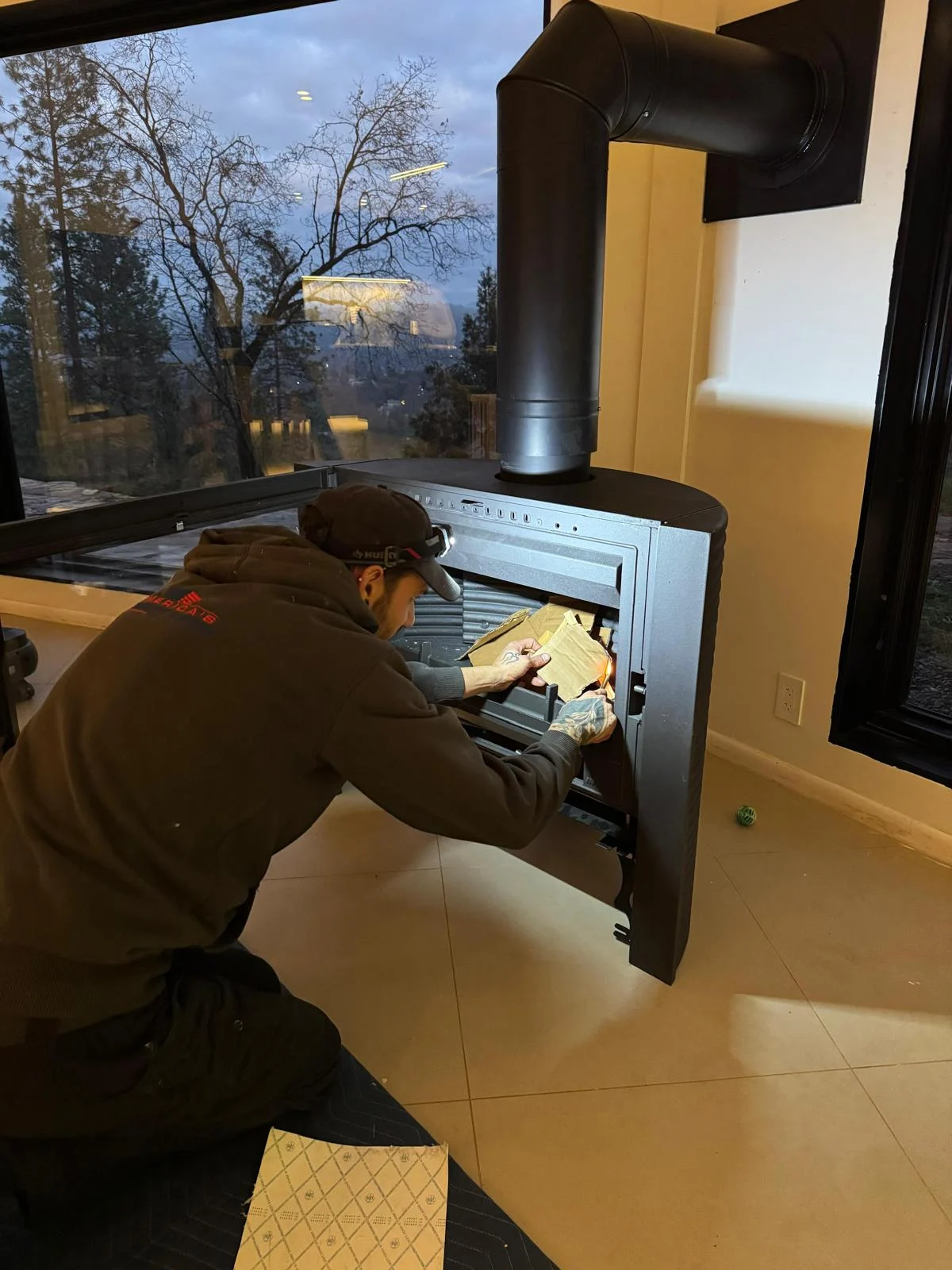
A fireplace insert is a sealed metal firebox that slides into an existing masonry fireplace opening and burns wood or gas far more efficiently than an open fire. The job means fitting the unit to the opening, running a liner sized to it, and sealing the connection so heat goes into the room instead of up the flue. Most installs touch the surround trim, too.
What a fireplace insert installation actually changes
Most of the heat a wood fire makes goes straight up the flue with the smoke. The room gets back whatever radiates off the open firebox, a fraction of what the fire is putting out. A sealed insert flips that. Air moves around the firebox shell and back into the room instead of escaping, so the same fire throws noticeably more heat where you’re sitting.
That’s the whole case for it. The opening you already have goes from decorative to functional without tearing anything out.
Here’s the part most people don’t expect. The insert box itself is rarely the expensive line on the job. It’s what has to happen behind it to make the box safe to run, and that’s the piece homeowners never budget for on their own.
Signs an insert makes sense for your fireplace
Not every fireplace is a good candidate. The reasons to install fireplace insert units cluster around the same few complaints.
| What you’re noticing | What it usually means |
|---|---|
| You build a fire and the room next to it never gets warm | Classic open-fireplace heat loss. An insert is built for exactly this |
| Wood bills are climbing and the house still feels cold | You’re burning a lot of fuel to heat the flue, not the room |
| You’re tired of the mess, or a burn restriction has you thinking gas | Worth comparing a wood insert against a gas insert before deciding |
| The fireplace opening looks fine but the flue tile inside is cracked or old clay | The inspection has to happen before an insert goes in either way |
| You want a zero clearance fireplace installation instead | Different job entirely. That’s a new manufactured firebox for new construction, not an insert going into an opening that already exists |
Wood insert or gas insert: two different jobs
An insert can go into most of the different types of fireplaces found in a Sacramento-area home. But a wood burning insert installation and a gas insert installation aren’t the same job. Not close. They’re two different trades wearing the same trim.
A wood insert is mechanical: a firebox, a liner sized to the flue, a surround. Sized and sealed, it runs on nothing but wood and draft. A gas insert adds a fuel line, a valve, and an ignition system. That’s where the job stops being purely masonry work. If you’re weighing wood against gas first, wood, pellet and gas stoves compared lays out the tradeoffs without pushing you toward either one.
C-29 Masonry covers the masonry side of an insert job, not gas fitting. Michael does the work himself. The $59 inspection tells you what the opening and flue need before any work starts.
Why almost every insert installation needs a liner too
An open masonry flue was built oversized for an open fire, on purpose. An insert’s exhaust is a fraction of that diameter. Connect it to an oversized, unlined passage and creosote condenses along the way instead of clearing the top. That’s the setup that causes a chimney fire.
So the insert gets its own liner, sized to its own exhaust, run the full height of the flue. That’s what makes the insert safe to run, not an upsell. It’s also the part almost nobody quotes over the phone, because the length and type depend on what the flue looks like once someone’s up there with a flashlight.
Fireplace insert installation cost in Sacramento
Six jobs get a starting number over the phone. Fireplace insert installation isn’t one of them, and that’s not an evasion, it’s how this business prices everything past the basics.
| Service | Starting price |
|---|---|
| Chimney inspection | $59, deductible against the job |
| Basic chimney cleaning | from $199 |
| Chimney cap installation | from $350 |
| Chimney crown rebuild | from $350 |
| Dryer vent inspection | $59 |
| Dryer vent cleaning | from $150 |
| Fireplace insert installation | Priced on site after the inspection |
Four things move that last line once the flue’s been seen: wood or gas, how much liner has to run and in which material, how much of the opening has to be modified, and whether a gas hookup is involved. Guessing at any of that over the phone isn’t a real quote, just a number picked to sound good.
If you want to see where insert and liner work sits against every other repair on the price list, check the price band before you commit to anything. Call (916) 833-2959 and ask for the $59 inspection, 7am to 7pm, seven days a week. It’s credited straight to the insert job if you go ahead, so the real number costs nothing extra to get.
How an insert installation gets planned
An insert job runs through the same stages every time, regardless of who ends up doing the gas portion of it.
- The opening gets measured and inspected. Width, height, depth, and the flue’s condition. That’s what the $59 pays for.
- The insert gets sized to the opening, not the other way around. A unit bought online off the firebox’s front dimensions often skips the depth and the flue’s inside diameter. It either doesn’t fit. Or it fits and can’t be lined properly.
- The liner gets sized and run. Length, offsets, and material depend on the flue, not a catalog number.
- The connection gets sealed and tested. Draft gets checked once everything’s in, rather than assumed beforehand.
Most insert installations take a day. Masonry changes, a new liner, or difficult access can stretch the work into a second day.
When you don’t need a new insert
If you burn four or five fires a winter for the ambiance and the cold room next door doesn’t bother you, an insert is solving a problem you don’t have. That’s a real thing to say out loud before spending real money.
An insert also isn’t the fix if the actual complaint is smoke backing into the room. That’s usually a draft problem or a dirty flue, and a $59 inspection sorts out which one it is before anyone talks about a new unit. Sometimes the honest answer is a cleaning, not an installation.
And a fireplace insert replacement isn’t automatic just because the current insert is old. If it’s still drawing correctly, sealing correctly, and the liner behind it is sound, replacing it is a preference call, not a safety one.
The mistake that costs people a second trip
The most common mistake: a homeowner buys the insert before anyone’s looked at the flue. It arrives, and the liner it needs turns out to be a different length or material than budgeted, because nobody measured the actual flue run first. The unit sits in a garage for a few weeks while that gets sorted out.
The inspection before the purchase, not after, is the whole point of doing it in that order.
What older Sacramento-area fireplaces bring to this job
Midtown and East Sacramento brick homes usually have an original clay tile flue. Never sized for anything but an open fire. The liner conversation isn’t optional on most of those jobs. Out in the 1960s and 70s tract housing across Carmichael and Citrus Heights, a lot of what looks like a masonry fireplace is a prefabricated metal firebox in a chase, and not every prefab unit is rated to take an insert at all. Most homeowners have no idea which one they own until someone points at it with a flashlight.
While I’m already at your fireplace
An insert call often turns into a second conversation, because the same flue and firebox that need an insert usually have something else going on nearby. A pilot that won’t hold a flame or a valve that drops out mid-burn is gas fireplace repair service territory, not an insert problem. A log set that was never centered right in an open masonry firebox is closer to a proper gas log installation service than a quick fix. And because almost every insert pulls a new liner with it, chimney liner installation in Sacramento covers the flue side of this same job in more depth than fits here.
What people say after the job
The rating sits at 4.95 across 62 Google reviews, and every one of the 62 has a real reply, not a template. You can read photos and write-ups from real jobs before deciding who’s coming to your house.
Service area
Insert and liner work runs across five counties out from Nevada City. Americas Chimney Sweep in Sacramento covers the valley pricing questions specifically, since that’s where most of the open-masonry, heat-loss complaints come from.
Fireplace insert installation FAQs
Is a fireplace insert worth it?
If the complaint is heat loss from an open fireplace, usually yes. That’s exactly the problem an insert solves. If the fireplace is mostly decorative and rarely used, the cost is harder to justify. The $59 inspection is the honest way to find out which category your fireplace falls into.
What does a gas fireplace insert cost?
There’s no number to give sight unseen. Gas insert installation adds a fuel line and ignition components on top of the same liner and opening work a wood insert needs, and it isn’t priced until both have been looked at. That’s what the $59 inspection covers.
How do I find fireplace insert installers near me who are actually licensed?
Ask for a license number first. Americas Chimney Sweep is licensed CSLB #1150991, C-29 Masonry, active, and you can look that number up on the CSLB site. That license covers the masonry side of an insert job. Any gas fitting portion needs its own qualified license.
What’s the difference between fireplace insert replacement and a first-time install?
The opening’s already been modified once, so a replacement usually skips the masonry prep a first install needs. It doesn’t skip the liner check. An old liner sized for the previous insert isn’t automatically right for the new one, and that gets confirmed at the inspection either way.
Do I need a permit for a fireplace insert installation?
Michael does the work himself. The $59 inspection sets the scope before anything starts.
Can any masonry fireplace take a zero clearance fireplace installation instead of an insert?
No. A zero clearance unit is a manufactured firebox built for new construction or a remodel where no masonry fireplace exists yet. An insert slides into an opening that’s already there. If you don’t have a fireplace at all, that’s the zero-clearance conversation, not this one.
Do I need a liner with a fireplace insert?
Almost always, yes. An insert’s flue outlet is much narrower than the open masonry chimney above it, and without a liner sized to that outlet, smoke and gases have too much cold surface to cool against before it clears the top. The exception is a chimney with an already-correct liner from a prior insert.
Gas insert or wood insert, which is the better fit?
A gas insert lights with a remote and needs a yearly service visit, nothing more from you. A wood insert heats harder on a cold night but means hauling wood, tending a fire, and an annual sweep once the creosote builds. Neither is the wrong choice, but they ask something different of you every winter.
How long does insert installation take?
A straightforward insert with an existing, correctly sized liner is often a one-day job. Add a new liner run, masonry surround work, or venting a gas line to the hearth, and it stretches to two days. The opening’s condition decides more of that timeline than the insert itself does.
What size fireplace insert do I need?
Size starts with your opening’s exact height, width, and depth, since an insert has to physically fit inside it. From there it’s about heat output matched to the square footage you’re trying to warm. A unit sized for a great room will run too hot and too often in a small den.
Schedule Service Today
An insert bought before the flue’s been seen is how a straightforward job turns into a unit sitting in a garage. Call (916) 833-2959 and ask for the $59 inspection, 7am to 7pm, seven days a week, and you’ll know what your opening and flue actually need before you spend on anything else. It’s credited straight to the job if you go ahead. Or grab a time slot and I’ll confirm the details by phone.