
No ladder required. Know which one you’ve got, and half the confusing advice online about chimneys stops applying to you.
Which one you have decides which repair path you’re on, and the six chimney repairs Sacramento homes need most break down almost entirely along this line. A rusted-through top means chase cover replacement in Sacramento. That’s a prefab problem only. Masonry doesn’t have a chase cover to rust.
A flue that’s cracked, spalling, or pulling apart at the joints usually points to chimney flue liner replacement instead. That’s almost always a masonry job, since a prefab flue is sized and sealed to one manufacturer’s unit.
This trips people up most often right after a move. Whoever built the house or the addition knew exactly which kind they put in. Nobody hands that information down. I get calls from people who bought a house eight years ago, watched a video about masonry crown repair, and climbed up to find a flat metal chase cover instead of anything a trowel could fix. Knowing which one you own before you start reading repair advice saves you that trip up the ladder.
Masonry vs prefab chimney: the 30-second check
Walk outside. Look at what’s actually holding your chimney up. A masonry chimney is stacked brick or stone, usually rectangular, and it runs straight down to its own footing in the ground, independent of the house framing.
A prefab chimney is different: a metal firebox and metal flue pipe, boxed inside a framed chase. That chase usually just sits on the roof or floor structure itself.
Here’s the fast test. Knock on it. Brick gives you a dead, solid knock. A prefab chase gives you a slightly hollow sound. You’re knocking on siding or stucco wrapped around framing and a pipe, not solid masonry.
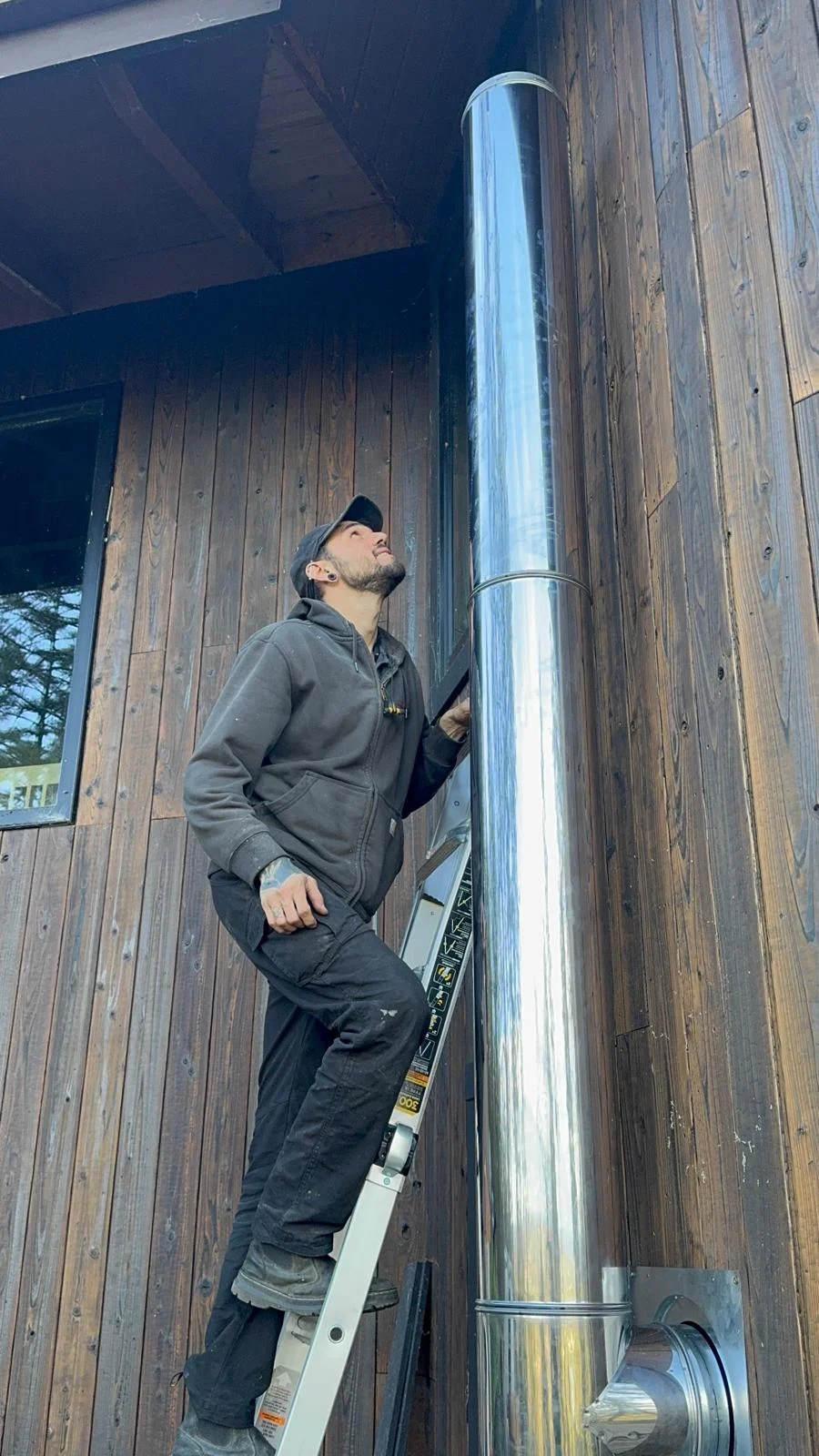
Check the top, too. Masonry ends in a poured concrete crown, with a flue tile and a cap sticking through it. Prefab ends in a flat metal chase cover, usually painted or galvanized, with a round metal pipe and a smaller cap coming through that.
One more check, if you’ve got attic access. Follow the chimney up through the floor above the fireplace. Masonry goes through as a solid brick or block pillar, with a small air gap to the framing around it. Prefab goes through as a round metal pipe, usually wrapped in a silver insulation blanket, with a lot more open space around it. That clearance is the whole reason it’s allowed that close to wood.
Field note: the giveaway most owners miss is inside the firebox, not out on the roof. Open the fireplace doors and look on the side wall or the floor for a small metal tag, usually riveted on. It’s stamped with a manufacturer name and a model or serial number. That tag only exists on a factory built fireplace. Masonry fireboxes get built brick and mortar in place, so there’s nothing to stamp.
Masonry and prefab, side by side
Here’s the comparison I actually work from on a job. Most of what changes about your chimney, the repair, the cost shape, even how old the neighborhood usually is, traces back to this one split.
| Masonry chimney | Prefab (zero clearance) chimney | |
|---|---|---|
| What it’s made of | Brick or stone, mortar joints, poured concrete crown | Metal firebox and metal flue pipe inside a wood-framed chase |
| Foundation | Its own footing, independent of the house | Usually rests on the roof or floor framing, no separate footing |
| Flue liner | Clay tile, or a stainless liner installed later | Insulated metal pipe sized to the manufacturer’s unit |
| Typical Sacramento-area build era | Pre-1950s and custom builds, Midtown, East Sacramento, Land Park | 1950s-70s tract housing, Carmichael, Citrus Heights, Arden-Arcade, Rancho Cordova |
| Most common failure | Cracked crown, spalling brick, deteriorated liner | Rusted-through chase cover, gasket failure |
| How it’s usually fixed | Crown rebuild, tuckpointing, liner replacement | Chase cover replacement, or full unit replacement |
Two of those repair lines have a real starting number behind them. A crown rebuild starts at $350. A chase cover replacement doesn’t work the same way, since there’s no single starting price for it. How much of the chase and the framing underneath got wet before anyone noticed changes the job completely, so that one gets priced on site, after the inspection, not off a description over the phone.
Zero clearance fireplace, prefabricated fireplace, factory built: same box, three names
If you’re searching around, you’ll see this system called a zero clearance fireplace, a prefabricated fireplace, or a factory built fireplace. All three point at the same thing. The name comes from the fact that, unlike masonry, these units are tested and listed to sit close to wood framing without the wide clearances a masonry chimney needs. Tract builders leaned on that hard in the postwar boom, building lighter and cheaper than laying brick lot after lot.
That listing only holds for the specific model it was tested with. A chase cover, cap, or liner pulled from a different manufacturer isn’t a universal fit, even when it looks close enough on the shelf. Close doesn’t count.
The cosmetic side is where most of the confusion starts. Plenty of prefab chases get wrapped in real brick veneer or stone to match the house, so from the driveway it can look exactly like a masonry chimney standing on its own footing.
It isn’t.
Peel back the question to what’s holding the structure up and doing the venting, not what’s glued to the outside of it. Do that, and the two stop looking anything alike.
What’s actually inside a metal chimney chase
The chase is the framed box on the outside of the house, wrapped in siding, stucco, or a thin brick veneer to look like it belongs there. Inside a metal chimney chase there’s almost nothing solid: a run of insulated pipe, some framing lumber, and open air around it for clearance. Mostly air. That’s why a prefab chimney weighs a fraction of a masonry one. It’s also why a builder could stack a second-story fireplace over a garage without pouring a separate foundation to carry it.
It also explains the most common failure. That chase cover on top is thin sheet metal. Sacramento’s wet season puts it through a real test every winter, five soaked months followed by seven bone-dry ones. Once it rusts through, water runs down inside the chase and rots the framing around the pipe long before anyone notices from the ground.
What else turns up while we’re looking
Whichever type you’ve got, a few problems show up on both often enough to mention here. Draft trouble and smoke rolling back into the room happens on masonry and prefab alike, and the smell is telling you something before smoke ever does. It’s usually the first sign either system gives. Construction and clearance requirements for both types trace back to the NFPA 211 chimney standard, the reference model building codes point to for how far combustible framing has to sit from either kind of chimney.
Cleaning changes too, not just repair. A masonry flue gets brushed to the shape of the tile, and a stiff brush handles most of what builds up in a season. A prefab flue is a fixed metal pipe diameter set by the manufacturer. The brush has to match that size closely, or it either misses buildup on the walls or scratches a liner that’s not meant to take that kind of abrasion. Grab the wrong brush size for a prefab system and you can do more harm than the soot was doing.
When the difference doesn’t actually matter
Most of the time, knowing which type you have is just useful to know. It’s not a reason to call anyone. If the fireplace draws clean, there’s no smoke smell in the room, and the chase cover or crown looks solid from the ground, you’re fine as you are. You don’t need a service call just because you now know it’s masonry or prefab. Simple as that.
It starts mattering the moment you’re planning a repair, buying or selling a house, or troubleshooting something that’s already gone wrong: draft problems, a smell, visible rust, or a crack you can see from the yard. That’s when the type you have decides what actually needs to happen next.
Can a prefab fireplace be converted to a masonry chimney?
Technically, yes. But it means tearing out the metal unit and building a real masonry firebox and chimney from a new footing up, including framing changes to carry the weight. It’s closer to new construction than a repair, and it’s priced on site after I’ve actually seen the structure, never off a phone call.
Is a factory built fireplace less safe than masonry?
Not inherently.
A zero clearance fireplace is engineered and tested as a complete unit, and it’s safe when it’s the model and clearances it was listed for. Where it goes wrong is neglect, mostly a rusted chase cover letting water into the framing, or parts swapped in from a different manufacturer’s unit.
Which one lasts longer, masonry or prefab?
A well-built masonry chimney can outlast the house it’s attached to, as long as the crown and flashing stay watertight and someone catches spalling before it eats into the structure. A prefab unit is only as good as its rated parts. The chase cover is almost always the first piece to fail, usually well before the metal firebox underneath is actually worn out.
I’m Michael, and I’m the one who comes out and looks, every time. And the same person does every job after that: whichever kind of chimney you’ve got, the guy telling you what it needs is the guy who’d actually fix it.
Are prefab fireplaces safe to use?
Yes, when the chase, cap, and clearances are all still doing their job. The real risk isn’t the metal firebox itself, it’s what happens after a remodel crowds insulation too close to the chase, or nobody ever checks the cap and flue for wear. Keep those maintained and a prefab burns as safely as masonry.
Can you actually convert a prefab fireplace to masonry?
Technically, yes, but call it what it is: a full masonry build, not a conversion. The metal unit and its chase come out completely, and you’re pouring a new footing and laying brick from the ground up. Most homeowners look at that price against a factory metal replacement and choose the metal every time.
Do prefab chimneys need liners?
Not in the masonry sense. A prefab unit already has its own listed metal flue pipe built in, engineered for that specific firebox, so there’s no separate liner to install. What that pipe can fail at instead is sections working loose or connections corroding, something a masonry liner never deals with.
How do I know if my fireplace is prefab or masonry?
Look inside the firebox itself. Real brick and mortar joints mean masonry. A textured panel, corrugated metal, or a manufacturer’s rating plate riveted somewhere inside means prefab. Still not sure, check the attic. Brick runs solid to the footing, prefab sits inside a framed wood chase instead.
How long do prefab fireplaces actually last?
There’s no fixed number, and anyone giving you an exact year count is guessing. What decides it is the metal firebox and flue pipe, since those parts, unlike brick, don’t get repaired piece by piece, they get replaced whole. Heavy daily burners in the foothills wear that hardware out faster than occasional valley fires.
If you’re still not sure
Some chimneys don’t sort cleanly from the ground, especially older homes where a chase got built around an original masonry stack, or additions where nobody kept the paperwork. Maybe you’ve read all this and you still can’t tell. Or you can tell, and you don’t love what you’re seeing on that chase cover or that crown.
Either way, the $59 inspection settles it in person. It’s deductible: if you move ahead with any repair, the $59 comes off the price of the job, and you only pay it on its own if you don’t. Call (916) 833-2959, 7 AM to 7 PM, seven days a week, and I’ll tell you straight which chimney you’ve got, and what, if anything, it actually needs.