
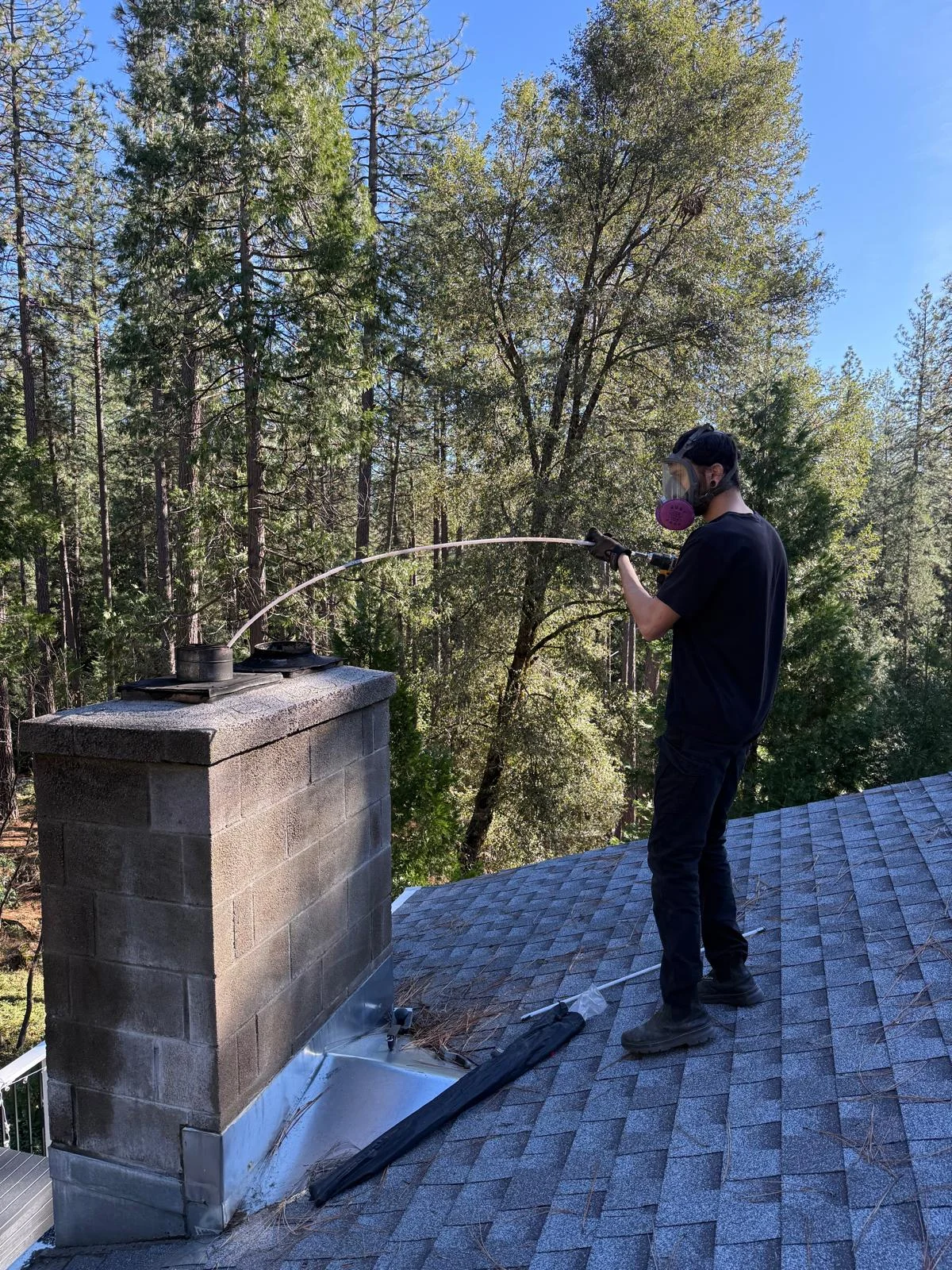
What that white staining actually is
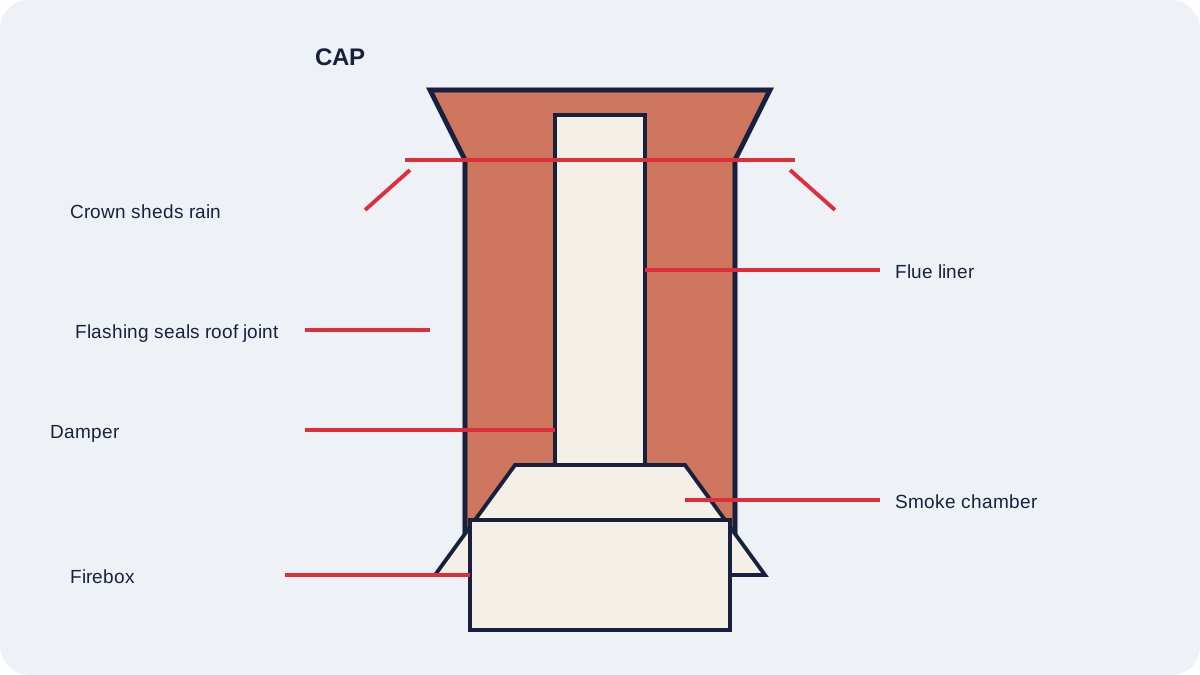
The chalky white residue is called efflorescence on chimney brick. It’s not mold, and it’s not dirt. It’s mineral salt, dissolved out of the mortar and brick as water soaks in, then left behind on the surface as that water evaporates. See it on your chimney and you’re looking at proof, not a guess, that water is passing through the wall itself.
Here’s what most people get backward: efflorescence isn’t the problem. It’s the chimney telling you where the problem is. By the time you see the white bloom, that brick has been wet inside for at least a full season, sometimes several.
Why sealer, and never paint
I get asked to paint a chimney more than you’d think, usually by someone trying to cover the staining instead of stop it. I won’t do it, and here’s why.
Brick is porous. It’s supposed to breathe, taking on a little moisture and releasing it again as the weather changes. A paint-on coating closes that pore structure from the outside. Water already inside the wall, or water finding a new crack somewhere else, has nowhere left to go. Trapped water behind a sealed face does more damage in one winter than an unsealed, weathered chimney does in five.
What works is a vapor-permeable water repellent. It closes the surface to rain hitting the brick directly, while still letting water vapor pass back out from the inside. The brick stays dry on the surface. It keeps breathing underneath. That distinction, sealer versus coating, is what separates a waterproofing job that lasts from one that quietly rots the wall behind a nice finish.
What it costs
Chimney waterproofing is priced on site, after I’ve actually looked at the brick. I won’t quote a number sight unseen. The price depends on how much surface area needs treatment and what’s found underneath the staining, and inventing a figure before that inspection would be a guess dressed up as a quote.
What I can tell you straight: the $59 inspection covers the same ground on every visit, whether that’s waterproofing, a crown check, or a leak you can’t place. If you go ahead with the work, that $59 comes off the total. You only pay it on its own if you decide not to move forward. If you want to see where waterproofing typically lands next to the rest of the repairs I run, check the price band before you commit.
Call (916) 833-2959, 7am to 7pm, seven days a week, and ask for the $59 inspection. You’ll have a real number for your chimney, not a range built for somebody else’s.
How the job actually happens
- I inspect the chimney top to bottom during the $59 visit, checking whether the water is coming through the brick face itself or entering somewhere else first, like a cracked crown or failed flashing.
- I clean the brick first. Any efflorescence residue comes off before anything goes on. Sealing over that residue just traps it under the new coat.
- I apply the vapor-permeable repellent to the masonry surface, working it into the joints as well as the brick face.
- The surface dries clear. Waterproofed brick still looks like brick. If it looks glossy or plastic afterward, that’s a film-forming coating, not a breathable sealer.
Most waterproofing work takes a few hours. The amount of masonry and a dry weather window decide whether it stays a single visit.
When you don’t need this yet
Not every chimney needs sealing. If the brick face is clean, dry, and shows no white staining after a wet winter, waterproofing isn’t due. Sealing a chimney that doesn’t need it yet is money spent early on a coat that will need reapplying again before it ever had a job to do.
The exception is different. It’s a chimney that’s already lost mortar or has a cracked crown. Sealing the brick over an active structural leak treats the wrong problem.
Water keeps coming in through the crack whether it’s sealed or not, and now it’s trapped behind a fresh coat instead of drying out between storms. Fix what’s actually letting water in first. Waterproof after, not instead.
While I’m up there
Waterproofing calls turn into a bigger conversation more often than people expect, because water damage doesn’t stop at the brick. If the firebox has been catching runoff for a while, I’ll flag it, and sometimes that means I replace the cracked panels inside the firebox the same visit instead of scheduling a second trip. A damper that’s rusted shut from sitting wet is another common find, and that’s a separate chimney damper repair service call, but I’ll tell you on the spot if I see it rather than let you find out next winter.
Why Sacramento chimneys need this at all
Sacramento gets almost all its rain between November and April and none the rest of the year. Brick spends five wet months soaking up water like a sponge and seven dry months baking it back out. That cycle alone would be manageable.
What breaks the masonry down is what happens on the cold nights in between: valley winter lows sit right around freezing, and water trapped in a pore expands as it freezes. Do that a few dozen times a winter and the surface lets in more water than it did the year before. Waterproofing doesn’t stop that cycle. It slows how fast the brick takes on water in the first place, and that’s most of the fight.
Also serving Folsom
Waterproofing calls come in from across the service area, and Folsom is a regular stop on the schedule. Older brick chimneys near the American River tend to show efflorescence sooner than newer builds further out, likely from river humidity paired with direct sun on south-facing brick. If you’re in that area, chimney cleaning Folsom CA covers the rest of what I run out there beyond waterproofing.
Proof this works
The rating sits at 4.95 across 62 Google reviews, and I reply to every one myself. You can read the rest at our customer reviews before you decide whether to book.
Waterproofing and sealing questions, answered
How much does chimney waterproofing cost?
There’s no set figure. It’s priced on site after the $59 inspection, based on how much brick needs treatment and what’s found underneath the staining. Two chimneys that look similar from the ground can need completely different amounts of prep work, so a number given sight unseen isn’t a real one.
What’s a fair cost to seal a chimney if I’m comparing quotes?
Be wary of any number quoted sight unseen. Someone has to actually look at the brick first. A real quote follows an inspection that checks whether the water is coming through the face itself or entering somewhere else, like a cracked crown. A price with no inspection behind it is a guess. Not a quote.
What is efflorescence on a chimney, and does it mean I need waterproofing?
Efflorescence is the white, chalky mineral deposit water leaves behind as it evaporates out of brick and mortar. Seeing it means water has already been moving through the masonry, so yes, it’s usually the clearest sign waterproofing is overdue. It’s a symptom worth checking rather than ignoring.
What’s the difference between a chimney water repellent and a paint-on sealer?
A water repellent is vapor-permeable. It keeps rain from soaking in while still letting moisture already inside the brick escape as vapor. A paint-on coating seals both directions, trapping existing moisture behind it. That trapped water causes more damage than the staining it was meant to cover.
Is chimney water sealing the same thing as waterproofing?
Same job. Just a different name people search for. Both describe treating the brick face with a breathable repellent so rain sheds off the surface instead of soaking in. The material and the method don’t change based on which phrase brought you here.
Does waterproofing chimney brick stop an active leak?
Not if the leak is coming from somewhere else, like a cracked crown or failed flashing. Waterproofing treats the brick face itself. If water’s getting in through a different opening, sealing the brick just traps it behind a fresh coat instead of stopping it. The $59 inspection sorts out which one you’re dealing with before anything gets applied.
Can you waterproof a chimney yourself?
You can buy a sealer and roll it on, but two things usually go wrong. People grab a paint-on product instead of a vapor-permeable repellent, which traps moisture instead of releasing it. And most chimneys need a ladder on a steep pitch to reach the whole face, which is where I’d stop.
Does chimney waterproofing actually work?
Yes, when it’s the right material applied to clean, dry brick. A breathable water repellent typically holds up five to ten years before it needs reapplying, and during that stretch it stops new rain from soaking in while trapped moisture keeps escaping as vapor. Skip the prep and it fails within a season.
How often should a chimney be waterproofed?
Roughly every five to ten years in most cases, but the real marker is the brick itself. If the white staining starts reappearing, or water starts beading less than it used to on the surface, that’s the repellent wearing thin. I’d rather check it at each inspection than guess at a fixed calendar date.
What kind of sealant do you use on a chimney?
A breathable, vapor-permeable water repellent, never a paint-on coating. It’s applied to the whole brick face, not just the crown or the mortar joints, since water works into the brick itself and not only the seams between them. That’s the same repellent I’d use whether it’s a hairline crack or the whole stack.
Book the inspection
White staining on the brick face rarely goes away on its own, and it usually gets worse the next wet season, not better. Call (916) 833-2959 and ask for the $59 inspection, available 7am to 7pm, seven days a week, and you’ll know whether it’s a sealing job or something upstream before you spend anything else. Or book a chimney sweep online and I’ll call to confirm the details.