
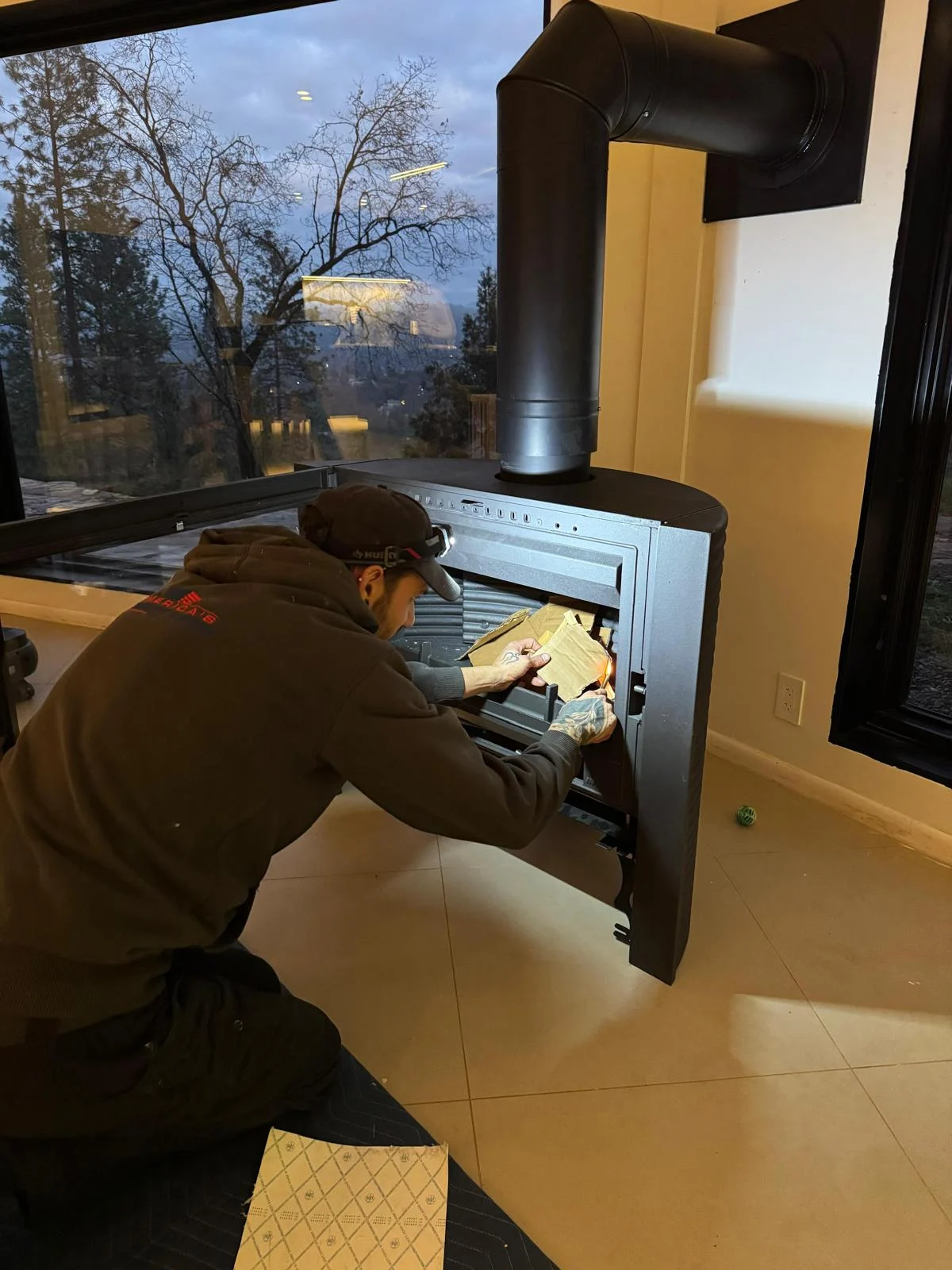
If you already know your flue has buildup from a few winters of wood that never really dried out, the fix isn’t a better moisture meter. It’s a look up the flue: start with a full cleaning and camera scan so you know what’s stuck up there. If the light shows a hard black glaze instead of loose soot, that’s a job for a creosote removal service, not a regular sweep. And if the plan is a new stove instead of babying the one you’ve got, get an EPA certified wood stove installation quoted the same way the fuel gets tested, before you assume the number on the box matches what happens on your hearth.
How do you test seasoned firewood moisture content?
Split a piece of wood you’re about to burn and press a moisture meter’s pins into the freshly exposed face, not the weathered bark. Seasoned firewood reads 20 percent or lower. Anything higher means water is still leaving the wood while it burns, stealing heat before it reaches the room.
The pins matter more than people think. A meter run across the bark or the weathered end of a log reads whatever dried out over the summer, and that’s almost never the number that matters. Split the piece first, then test the inside. That’s the face that was still wet a minute ago, and it’s the number that tells you what’s going to happen in the firebox.
Under 20 percent, wood lights faster, burns hotter, and produces a visibly different flame, more orange, less black smoke rolling off the top log. Above 25 percent, you’ll hear it. A hiss and sizzle at the ends as the fire tries to boil water out before it can burn anything.
What happens when you burn wood over 20 percent moisture?
Water has to boil off first. Every pound of it in a log has to leave before that log can burn hot enough to combust cleanly, and that takes heat away from the fire itself. The smoke that results is cooler and thicker, and cooler smoke condenses on its way up a flue instead of escaping, which is exactly how creosote starts.
Think of it as two jobs stacked on top of each other. First the fire has to drive off the water, which is pure energy loss. None of that heat reaches your living room. Only after the wood is dry enough does it start combusting the wood itself. Wet wood spends most of its burn stuck on step one.
That’s also why wet wood glazes a flue faster than dry wood burned the same way, season after season. The smoke off a wet fire is heavier and cooler, and it carries more unburned particles up the chimney. Cool smoke is exactly the condition that turns those particles into a hard glaze instead of the dry, flaky buildup a brush clears out in minutes. The EPA’s Burn Wise program uses the same 20 percent line for a reason: it’s the point where a fire stops fighting its own fuel.
How long does firewood take to season?
Most hardwood needs six months to a year, split and stacked, before it’s ready. Oak often needs closer to two. Softer woods like pine season faster, sometimes in six months. But the calendar matters less than the setup: split, stacked off the ground, and exposed to sun and wind the whole time.
Splitting is what starts the clock. A round log dries from the outside in and can sit for years without the center ever reaching 20 percent, because the bark is doing its job and keeping moisture in. Split the face open and both ends of a log dry at once, which cuts that time down by more than half.
Stacking matters almost as much. Wood piled straight on dirt pulls moisture back up from the ground faster than the sun can pull it out. A pallet, a few inches of gravel, or even scrap lumber under the stack keeps the bottom rows drying at the same rate as the top.
What does properly seasoned firewood look, feel, and sound like?
Seasoned wood is lighter than it looks. It has cracks radiating out from the center of the cut ends, and the bark is loose or gone. Knock two pieces together and you’ll hear a sharp crack instead of a dull thud. Green wood is heavier. The bark clings tight, and the cut ends show no cracking.
| Sign | Seasoned wood (under 20%) | Green or wet wood (over 25%) |
|---|---|---|
| Weight | Noticeably lighter for its size | Heavy, almost waterlogged in hand |
| Cut ends | Cracks radiating out from the center | Smooth, no cracking |
| Bark | Loose, peels off easily or already gone | Tight, hard to pull away |
| Color | Gray or faded, sometimes with darker streaks | Fresh, pale, almost like a live tree |
| Sound | Sharp crack when two pieces knock together | Dull thud, almost no ring |
| Burning it | Catches fast, mostly orange flame, little smoke | Hisses at the ends, heavy black smoke, hard to keep lit |
Is the wood on the sign really seasoned?
Not always. There’s no way to tell from a flyer or a guy with a truck full of logs, because “seasoned” isn’t a regulated word. The only way to know for certain is to split a piece yourself and test the inside face, the same way you’d check anything else somebody’s selling you sight unseen.
Field note: I’ve tested wood a homeowner swore had been sitting for two years, split it fresh, and watched the reading jump from 14 percent on the weathered outer face to 34 percent an inch under the bark. The outside of a round dries in a season. The middle can still be green three winters later if it was never split. That’s the whole reason the test only means something on a face you just cut open, not the log sitting in the rack.
When isn’t wet wood the problem?
Sometimes the wood tests fine. The chimney still smokes or smells, and that’s not a fuel problem anymore. A weak draft, a clogged cap, or buildup from years before this wood pile existed can all cause the same symptoms dry wood is supposed to fix, and no amount of seasoning solves those.
Test your wood before you blame it. If it reads under 20 percent and the fireplace still smokes into the room, smells musty in summer, or won’t draw right on a cold start, the moisture content isn’t what’s wrong anymore. Something else is sitting in the way.
A closed-up chimney collects more than dust over a summer. Birds and squirrels get into an uncapped flue looking for a dry place to nest, and there is a right way to get it out that doesn’t involve poking a broom up there and hoping. And if the wood pile question is coming up because the house is about to change hands, not because you’re planning to burn through another winter, a chimney inspection before selling answers a different question. It tells you whether the whole system is safe, not just whether the fuel is dry.
Three ways in, depending on which one’s yours:
- If you just want a look inside, start with a full cleaning and camera scan.
- If a flashlight already showed a hard black glaze instead of loose soot, go straight to a creosote removal service.
- If the real plan is replacing the stove instead of babying it through another season, ask about an EPA certified wood stove installation.
Why does seasoning take longer some years around Sacramento?
Sacramento gets almost all its rain between November and April and none the rest of the year, so wood stacked and covered on top dries fast through a long, dry summer. The catch is timing. Wood split in October won’t be ready for the fire that same winter, no matter how hot the summer was.
Foothill towns like Grass Valley, Nevada City, and Pollock Pines burn wood as primary heat, not ambiance, often daily from November through March. That kind of use burns through wood fast. This year’s stack has to have been split back in spring, not last month. Down in the valley, most homes burn four to ten fires a season, so the moisture rule comes up less often. It still matters the one night it’s cold.
Sacramento Metro AQMD also runs a mandatory wood-burning program most winters under Rule 421, and a smoky, wet-wood fire is exactly the kind that gets a household flagged on a no-burn day. Seasoned wood burns cleaner regardless. That’s one more reason to get ahead of it before the first cold snap, not after.
Who’s checking your wood and your flue
Michael is the only technician who works Americas Chimney Sweep jobs. He’s the one who’ll tell you whether what’s in your flue is a moisture problem or something else, not a script read off a screen. Before he’s on your roof or in your firebox, see who we send out. Americas Chimney Sweep is licensed CSLB #1150991. C-29 Masonry, active and current.
None of this replaces an actual look up your flue. Testing your wood tells you what you’re burning, not what already built up from the winters before you started checking.
Call (916) 833-2959 and ask for the $59 inspection. It comes off the price of the job if you decide to go ahead with the work. Skip the work, and that’s the only charge for the visit.
Michael answers seven days a week, 7am to 7pm.