
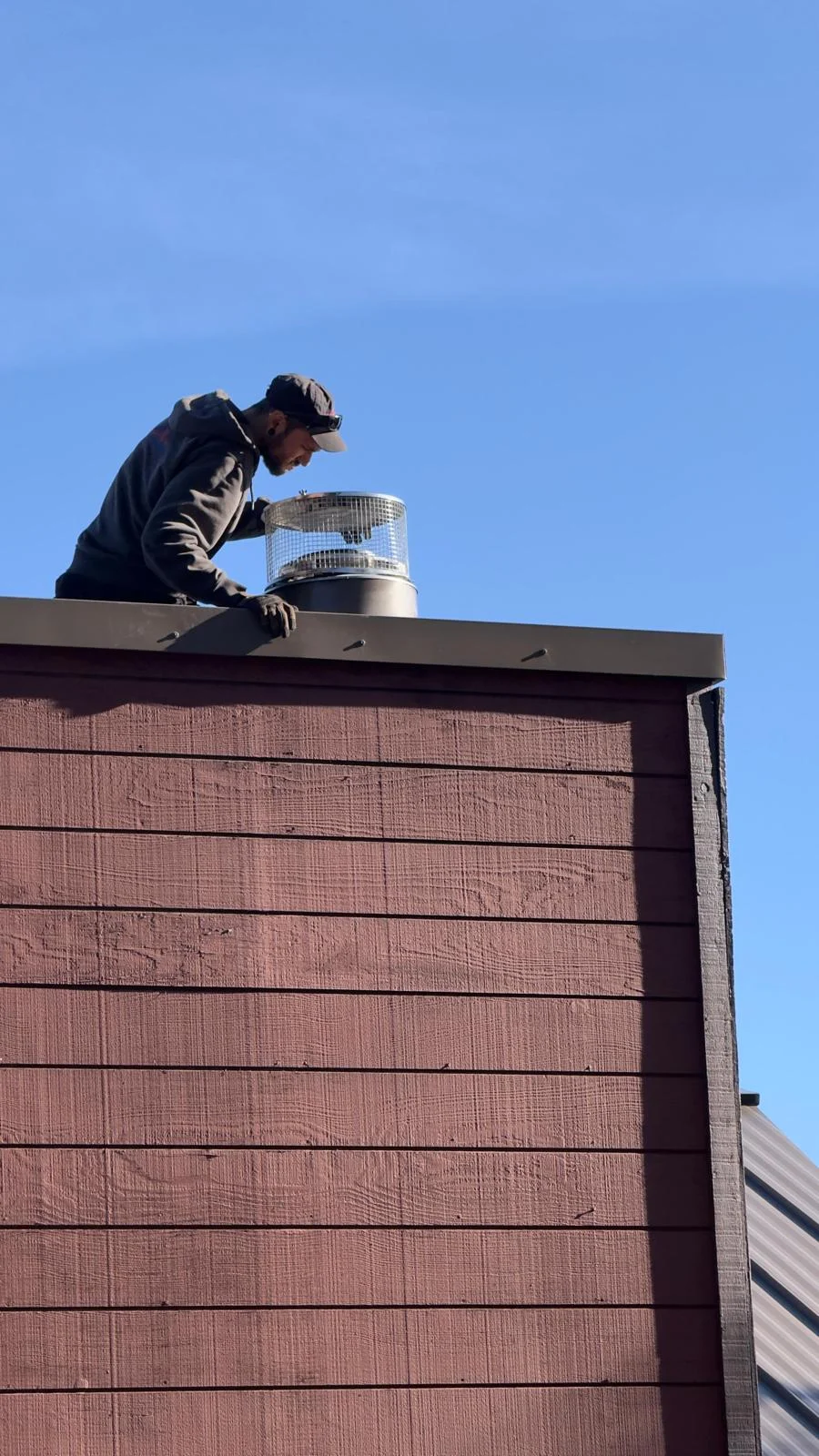
If you already know why you’re calling, skip ahead. Book a chimney camera scan inspection for a home sale or an unexplained crack or smell, get a plain answer on when you need a chimney inspection before you burn this fall, or check level 1 and level 2 inspection prices before you pick up the phone.
What are the three levels of a chimney inspection?
A Level 1 is a visual check of everything reachable without tools: the firebox, damper, crown, cap, and flashing, plus as much of the flue as a flashlight and a mirror show. A Level 2 adds a video scan down the full flue. A Level 3 goes further, opening part of the structure itself. That’s the whole scale, start to finish.
The three-tier system isn’t a marketing invention. It comes from NFPA 211, the standard the National Fire Protection Association publishes for chimneys, fireplaces, vents, and solid-fuel appliances, and it’s the same framework every legitimate inspector in the country works from, not just the ones in California.
The standard numbers them for a plain reason: without a shared definition, “chimney inspection” means whatever the person on the phone assumes it means. That’s where mismatches happen, between what a homeowner books and what a lender, insurer, or buyer’s agent actually needs in hand. A number removes the guesswork. Ask for a Level 1 or a Level 2 by name, and everyone on the call means the same thing.
What does a Level 1 chimney inspection include?
A Level 1 covers the firebox, damper, smoke chamber as far as a mirror reaches, crown, cap, spark arrestor, and visible flashing. It’s a full walk-through of a chimney that’s been swept and inspected on a normal schedule, with nothing new going on since the last visit.
This is the level almost everyone actually needs. If your chimney has no recent history of a fire, a new liner, or a sale in progress, a Level 1 is the correct starting point every single time, not a cut corner. It’s usually enough. The trade only escalates past it when something specific calls for more.
What a Level 1 doesn’t do is put a camera past the first bend in the flue. That’s the whole distinction between it and a Level 2, and it’s the detail that trips people up most. A thorough Level 1 can still catch a lot: a hairline crack across the crown, a damper that won’t seat flush, mortar pulling away at the flashing line. It can’t confirm what’s happening deeper in the liner. Nothing about a Level 1 reaches that far.
What does a Level 2 chimney inspection include?
A Level 2 includes everything in a Level 1, plus a video scan down the full length of the flue, joint by joint, past every bend a flashlight can’t reach. It also covers the readily accessible parts of the attic, crawlspace, and basement where the chimney passes through. It’s the level a lender or insurer usually wants in writing.
A mirror shows the first foot or two, then the flue disappears around a bend. Nobody can see past that with a flashlight, and that gap is the whole reason a Level 2 exists. A camera goes where a mirror physically can’t, and it either confirms the liner is sound or shows exactly where it isn’t.
Once the camera is down there, it’s checking a specific list, not just recording footage for the sake of it:
- The liner’s material and condition, section by section, not just at the visible top.
- Every bend and offset a flashlight and mirror never reach.
- Creosote or glaze built up on the flue walls, and how thick it’s gotten.
- Separated joints or gaps in a clay-tile liner where heat and debris collect.
- Any spot where the liner has cracked, warped, or pulled away from the flue wall.
A written report follows the scan. That’s usually the whole point of booking a Level 2. A lender or agent doesn’t want a verbal “looks fine.” They want the video and a summary they can put in a file.
What does a Level 3 chimney inspection involve?
A Level 3 chimney inspection is the rare one. It can mean opening part of the chimney structure, a wall, or a section of roof, to get at something a Level 1 or Level 2 flagged but couldn’t confirm from the inside. The rest is priced on site, after someone has looked at it.
Removal is the whole reason it’s the last resort, not the first option. A Level 1 or Level 2 answers almost every question with nothing torn open. A Level 3 only gets triggered when a camera has already found something serious enough that leaving it unconfirmed isn’t a reasonable choice, like a suspected breach between the flue and combustible framing after a fire. It’s not a routine upgrade. Nobody books one the way they’d book an annual check.
Chimney inspection levels at a glance
| Level | What it checks | Typical trigger |
|---|---|---|
| Level 1 | Firebox, damper, smoke chamber, crown, cap, flashing, and the flue as far as a flashlight and mirror reach. | Annual check-up on a chimney with no changes and no recent incidents. |
| Level 2 | Everything in Level 1, plus a full video scan of the flue interior and accessible attic, crawlspace, or basement chimney runs. | Home sale, new liner or appliance, fuel-type change, a chimney fire, or a Level 1 finding a crack or smell it can’t fully explain. |
| Level 3 | Everything in Level 1 and 2, plus removal of some part of the chimney or building to access a suspected hidden hazard. | Serious hazard suspected after a Level 1 or 2, most often following a chimney fire. |
Which level do you actually need?
For most homeowners, the answer is Level 1. It isn’t close. If nothing about your chimney has changed since last year and you haven’t had a fire, a Level 1 covers what needs covering. You don’t need a camera to confirm what a flashlight and a trained eye already tell you.
Where people get this wrong is escrow. Half the calls I get for a quick pre-sale inspection are actually asking for a Level 2 without knowing the term. The listing paperwork says “chimney inspection,” nothing about a camera, and the buyer assumes a flashlight covers it. It doesn’t.
A lender reading a Level 1 report on a sale that needed a Level 2 will send you back out for a second visit, on a tighter clock. Say the word “escrow” or “sale” when you call, and whoever’s booking sorts out which level you actually need before a technician shows up.
| Your situation | Level that fits |
|---|---|
| Annual check-up, nothing’s changed, chimney’s behaved fine | Level 1 |
| Just moved in, no history on the chimney | Level 1, moving to Level 2 if anything looks off |
| Buying or selling, and the deal needs it in writing | Level 2 |
| New liner, new appliance, or the flue changed in any way | Level 2 |
| Chimney fire, no matter how small it looked | Level 2, possibly Level 3 |
| A Level 1 or 2 found something it couldn’t fully explain | Level 3 |
When you don’t need a Level 2 or Level 3
If your chimney was swept and inspected within the last year, nothing’s changed, and you’re not in the middle of a sale, a Level 1 is genuinely enough. Paying for a camera scan every year on a chimney behaving normally is money spent confirming what the visual check already told you for free. Level 3 is narrower still. It comes up after a Level 1 or Level 2 leaves a real question unanswered, not as a routine option anyone should ask for by default.
Who decides which level you need, you or the inspector?
You start it. The inspector finishes it. You tell whoever’s booking why you’re calling, an annual check, an escrow deadline, a strange smell. That answer usually sorts most calls into Level 1 or Level 2 before anyone’s on the roof.
The final call belongs to whoever’s actually looking at the chimney, because a Level 1 can turn into a Level 2 mid-visit if something shows up that the flashlight can’t explain. Nobody schedules a Level 3 in advance. It only ever follows a Level 1 or Level 2 that came back with a real, unanswered question.
Ready to book, or still deciding?
If the table above pointed you to Level 2, the fastest path is a chimney camera scan inspection, since that’s the visit that actually runs the camera. If you’re not in a rush and just want the annual check before burn season, read when you need a chimney inspection before you burn for the seasonal version. And if the only thing left to settle is cost, level 1 and level 2 inspection prices breaks down every starting number on one page.
Does where you live in Sacramento change which level you need?
Not the level. The timing. Nevada City, Grass Valley, and the rest of the foothills use wood as the main heat source, not backyard ambiance, so a chimney up there builds creosote much faster than one down in the valley.
A foothill chimney can build a season’s worth of buildup in one winter that a valley home in Sacramento or Roseville takes two or three years to match. That doesn’t push you to a Level 2. It just means the same flashlight-and-mirror check that’s plenty for a once-a-winter valley fire needs to happen more often up in the hills, or the buildup outruns it.
Housing stock plays into it too. A 1960s prefab metal fireplace in Carmichael or Rancho Cordova has a simpler, more self-contained flue than an unlined brick stack in Midtown or East Sacramento built decades before liners were required. Both get the same Level 1 by default. The older masonry stack is the one more likely to turn up something that bumps it to Level 2, since it has more joints, more bends, and more decades for a crack to have started in.
NFPA 211 doesn’t have a Sacramento version. What changes locally is how often a normal chimney needs the visit, not what the visit covers.
What else turns up during any level of inspection?
Whatever level you book, it’s worth knowing what else commonly surfaces once someone’s actually looking. If a Level 1 finds something beyond normal wear, match the symptom to the cause is the fastest way to see what a specific crack, stain, or smell usually means before you assume the worst. And if you’re weighing whether your fireplace type even needs the same inspection schedule as a neighbor’s, see how the options compare across wood, gas, and pellet setups.
Who actually runs the inspection?
Every level, from the flashlight-and-mirror pass to the camera and anything past it, is run by the same person. There’s no dispatch. No rotating crew sending out whoever’s free that day. Americas Chimney Sweep is licensed under CSLB #1150991, C-29 Masonry, and if you want to see who’s actually walking your roof before you book, see who we send out.
Google has the business at 4.95 across 62 reviews as of this writing, small enough to actually read instead of trusting an average. Every one of them got a personal reply, not a template.
What’s the real difference between level 1, 2, and 3 chimney inspections?
The difference is access, not thoroughness. Level 1 is a visual check with a flashlight and mirror, no tools beyond that. Level 2 adds a video camera down the flue to see what the eye can’t reach. Level 3 goes further still, removing chimney components to inspect what’s hidden behind them.
When is a level 3 chimney inspection actually required?
Level 3 gets called for after a chimney fire, when a Level 2 scan finds hidden damage nobody can reach without removing part of the chase or wall, or when a hidden hazard is suspected and no other inspection could confirm it. It’s the rare exception. Most Sacramento homes will never need one.
Who actually sets chimney inspection standards?
The National Fire Protection Association writes the standard the whole trade works from, NFPA 211, currently the 2024 edition. It covers chimneys, fireplaces, vents, and solid fuel burning appliances, and it’s what defines the three inspection levels used industry-wide. Local jurisdictions can layer their own code on top of it.
How long does each level take?
A Level 1 usually runs 30 to 45 minutes on a single-flue home with normal roof access. A Level 2 takes longer, since the camera has to run the full length of the flue and every bend slows it down.
Multiple flues or a steep, wet roof add time to either one. A Level 3 depends entirely on what gets opened up. There’s no standard window for it.
Cleaning isn’t part of any of the three levels. Not even one of them. If an inspection turns up buildup instead of damage, that gets priced and scheduled separately, only if the visit calls for it.
Most calls start with the same question: is this a Level 1, or does it actually need the camera. Say what’s going on when you call, a smell, a stain, an escrow deadline, or just the date on last year’s sweep, and you’ll get a straight answer on which level fits before anyone’s on the roof. Every level starts with the same $59 inspection, credited into the job if you go ahead with whatever it finds. Call (916) 833-2959, open 7 a.m. to 7 p.m., seven days a week.