
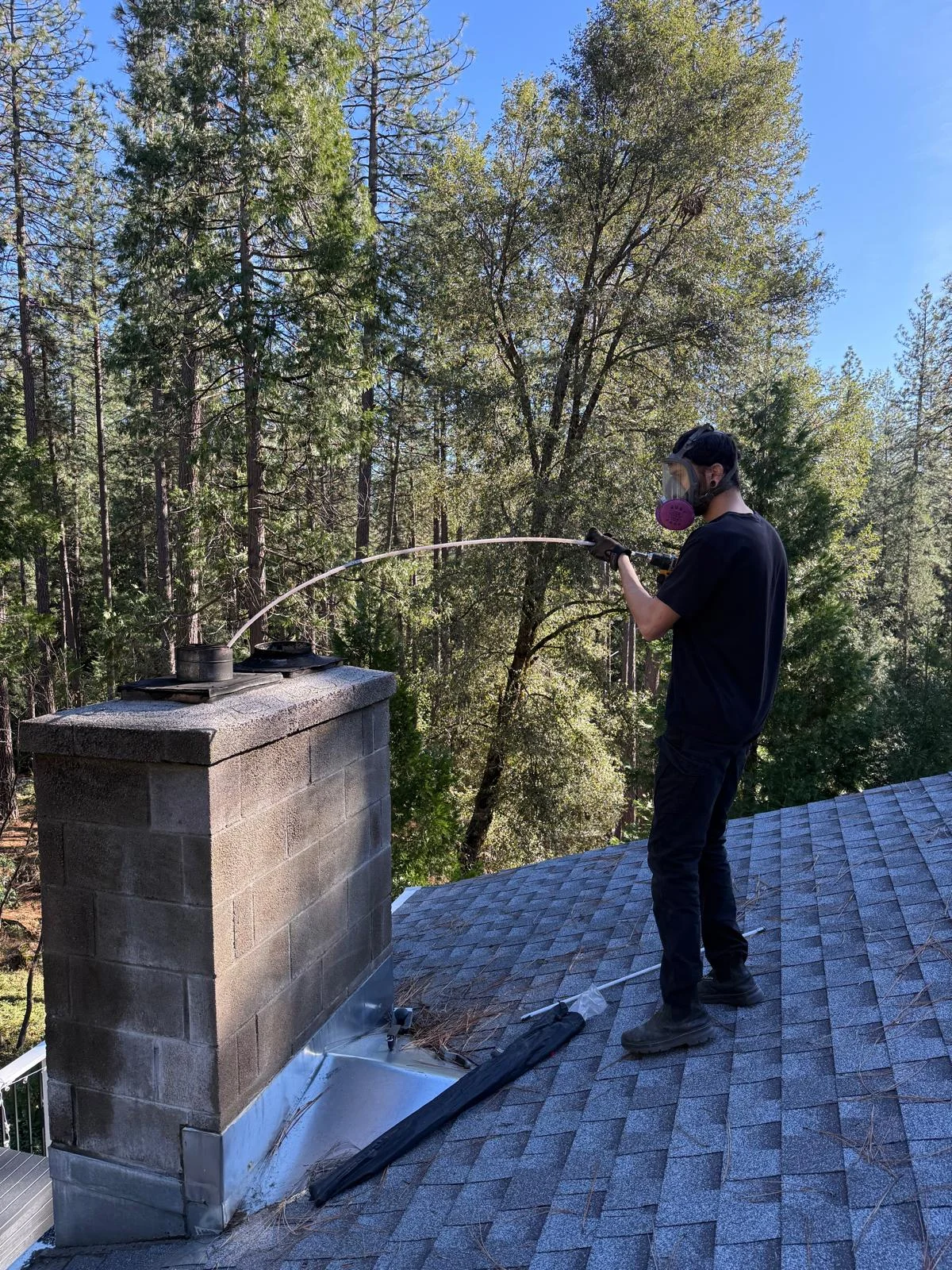
The most common cause is creosote already inside the flue, and it smells strongest in summer for a simple reason: no fire is running to pull air up and out, so warm, humid air just sits there. Once the air conditioning kicks on, it can pull that air back down into the room. It no longer drifts out.
Two things usually fix it. If the buildup is heavy and glazed, that’s a job for glazed creosote removal, not a quick brush pass.
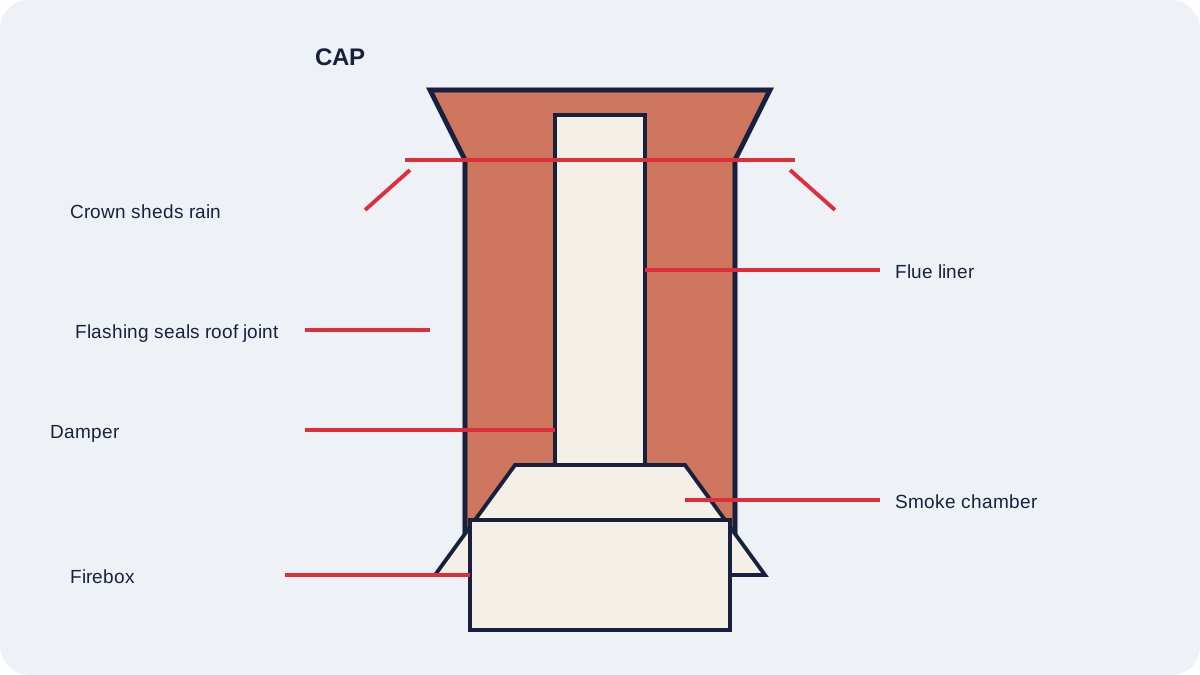
If the smell tracks with the AC running rather than the weather, a damper that won’t seal is often the real leak. That calls for chimney damper repair in Sacramento instead of the flue itself. Either way, a chimney sweep service that starts with a light up the flue tells you which one you’ve got, so nobody’s guessing.
What’s actually causing the smell, ranked by how often I see it
I get more calls about chimney odor in July and August than I do in December, when the fireplace is actually getting used. Here’s what’s usually behind it. Most common first.
| What it smells like | Likely cause | What confirms it |
|---|---|---|
| Campfire or tar, stronger once the AC runs | Creosote sitting in the flue | Flashlight in the firebox: flaky black soot or a hard, shiny glaze |
| Damp basement or wet cardboard | Water getting into the chimney | Staining around the chase, worse right after rain |
| Barnyard, ammonia, or scratching sounds | An animal or old nesting material in the flue | Smell spikes after rain, sounds from inside the chase |
| Rotten egg or sulfur | A gas leak, not the chimney | Leave the house and call the gas company, don’t investigate it yourself |
1. Creosote buildup
Creosote is what’s left behind when wood smoke cools faster than it should on its way up the flue. It’s tar, soot, and unburned wood particles, and it holds onto moisture. Humid summer air makes it release more of that tarry, campfire smell than a dry Sacramento winter does.
Look inside the firebox with a flashlight. Dry, flaky black soot is stage one, and a brush handles it in minutes. A hard, shiny black glaze is stage three, and no brush touches that kind. That’s glazed creosote removal, not a weekend project.
2. A damper that won’t seal
Outside air pulls straight down an open or poorly sealed damper, and it carries the flue smell with it. Confirm it by checking whether the damper closes flush when you work the handle or pull cord, and whether the smell gets stronger right as the AC or furnace kicks on. A stuck-open damper is worth fixing on its own, smell aside. It’s heated or cooled air going straight up the chimney every time the system runs.
3. Something living, or that used to be, in the flue
Birds and squirrels get into an uncapped or poorly capped flue more often than most homeowners expect. Nesting material and droppings smell worse than creosote once they get wet, and a dead animal in the flue is the same problem with a sharper edge to it. Confirm it by checking for scratching sounds, or a smell that got noticeably worse right after a rain.
This isn’t a DIY fix. A missing or damaged cap is usually behind both this and the water problem below, and installing one starts from $350.
4. Water sitting in the chimney
A damp, musty smell rather than a smoky one usually points to water getting in through a cracked crown or failed flashing, not through the flue opening itself. Sacramento gets almost all its rain between November and April and none the rest of the year. Masonry here goes through a long soak, then a long bake, every single year, and that cycle is what cracks a crown in the first place. Confirm it by checking for staining around the chimney chase or a smell that’s worse right after a wet week.
5. A gas smell
A rotten-egg or sulfur smell near a gas fireplace or gas line isn’t a chimney odor. Leave the house. Don’t touch a light switch on your way out. Call your gas utility or 911 once you’re clear. Michael does the work himself, but the utility handles the immediate gas emergency first.
When to stop and call someone instead of checking it yourself
Any gas or sulfur smell means get out and call the gas company, full stop. Don’t wait to see if it fades.
Anything that would mean climbing onto the roof to look down the flue is also a good place to stop. A sweep checks the flue from the firebox with a light and, when needed, a camera. None of that requires you anywhere near the roofline.
The same goes for a smell paired with a stain on the ceiling or a soft spot in the flashing. That’s water getting in somewhere it shouldn’t. Poking at it from a ladder usually makes the leak worse before anyone finds the source.
When you don’t need to worry about it
A day or two of fresh soot smell right after a sweep is normal. The flue’s been disturbed and it settles on its own. It’s not a sign anything went wrong.
Same for a faint campfire smell that only shows up right at the firebox on a still, humid evening and clears out once the air starts moving again. If it fades within a few days and doesn’t come back, leave it alone.
While we’re on the topic
Two things get confused with a chimney smell. A gas fireplace can develop its own odor even though it never produces creosote. The causes are different, and do gas fireplaces need cleaning covers that on its own. And if the smell showed up right after a smoky week outside rather than building up gradually, don’t assume it’s the chimney at all. Wildfire ash gets pulled into the return air the same way through the HVAC system, and the smell does not leave on its own until the ductwork gets addressed too.
Why summer makes it worse here specifically
That same wet season and bone-dry stretch don’t change how creosote forms. They change how strongly you smell it.
By August, the flue’s been sitting warm and unused for months, and the house around it has been sealed up and air conditioned the same amount of time. In a newer, tightly built home out in Rocklin or Roseville, that sealing is aggressive enough that running the AC drops the house pressure just enough to pull air down a chimney that would otherwise sit still. Older homes around Midtown or East Sacramento, with more gaps around doors and windows, don’t pressurize the same way. They often don’t smell it as strongly, even with a similar amount of buildup sitting up top.
It’s mostly a valley problem, not a foothill one. In Grass Valley or Nevada City, wood is the actual heat source through winter, so the flue’s in near-constant use and creosote never gets months to sit undisturbed through a hot, humid stretch.
In the valley, most fireplaces get lit four to ten times a season for ambiance, and the flue can sit completely untouched from March straight through October. Nobody expects a chimney that hasn’t been used in months to be the source of a smell.
Michael runs every inspection himself. There’s no dispatcher sending someone else in his place. If you’d rather know the person who does this work before he’s standing in your driveway, that’s on the site.
Americas Chimney Sweep is licensed through the CSLB for masonry work, C-29, #1150991. The rating sits at 4.95 across 62 Google reviews, and Michael has answered every one of them himself.
Once you know which of the five it is, the $59 inspection is the fastest way to confirm it instead of guessing from a smell alone. It folds into the job price if you go ahead with the fix. If you don’t, it’s the only charge. Call (916) 833-2959, 7am to 7pm seven days, and ask for it by name.